OpenPhone/Quo vs Google Voice

OpenPhone/Quo vs Google Voice for AI receptionists.

OpenPhone/Quo is usually the better small-team upgrade when AI answering, summaries, transcripts, and follow-up ownership matter. Google Voice is better when the buyer mainly wants a simple Workspace-connected phone layer.

Checklist for comparing OpenPhone or Quo with Google Voice before AI receptionist deployment.

Direct answer

Choose OpenPhone/Quo for AI-first small-team workflow; choose Google Voice for Workspace simplicity.

The decision is not just price. The buyer should decide whether the AI receptionist must create a usable team follow-up record after every call or whether the business only needs a simple phone number and basic forwarding.

If the call path requires SIP, LiveKit, or custom CRM writes, compare implementation paths instead.
Updated 2026-06-21 Comparison built for the AI receptionist use case

This page is narrower than a generic phone comparison. It focuses on first-answer behavior, call summaries, team follow-up, fallback, and what happens when a caller needs a person.

Decision matrix

CriterionOpenPhone/QuoGoogle VoiceEdge
AI answering pathSona-style AI agent, summaries, transcripts, tags, and team follow-up direction.Useful Google AI features such as spam blocking and voicemail transcription, but less purpose-built for AI receptionist operations.OpenPhone/Quo
Shared ownershipBetter fit when multiple people need visibility, summaries, and customer follow-up.Better fit when Workspace users need a simple phone add-on and admin model.OpenPhone/Quo
Workspace fitWorks as an app-first phone layer outside Google admin.Direct fit for teams already standardized on Google Workspace.Google Voice
Custom AI voice infrastructureStill not the same as SIP, LiveKit, PBX, or carrier-level control.Usually not the right base for custom SIP/LiveKit routing.Neither

Best-fit scenarios

Choose OpenPhone/Quo

The team needs AI answering plus follow-up workflow

OpenPhone/Quo is stronger when calls need summaries, transcripts, next steps, CRM-style follow-up, and shared team visibility after the AI or human call.

Choose Google Voice

The business mainly wants Workspace phone simplicity

Google Voice is stronger when the buyer wants a simple Workspace-connected phone number, basic forwarding, voicemail transcription, admin, and plan-based routing controls.

Choose custom implementation

The AI receptionist needs more than either phone app

Move to SIP, PBX, LiveKit, or implementation support when the call path needs custom transfer packets, CRM writes, monitoring, compliance rules, and failover.

Proof checklist before switching

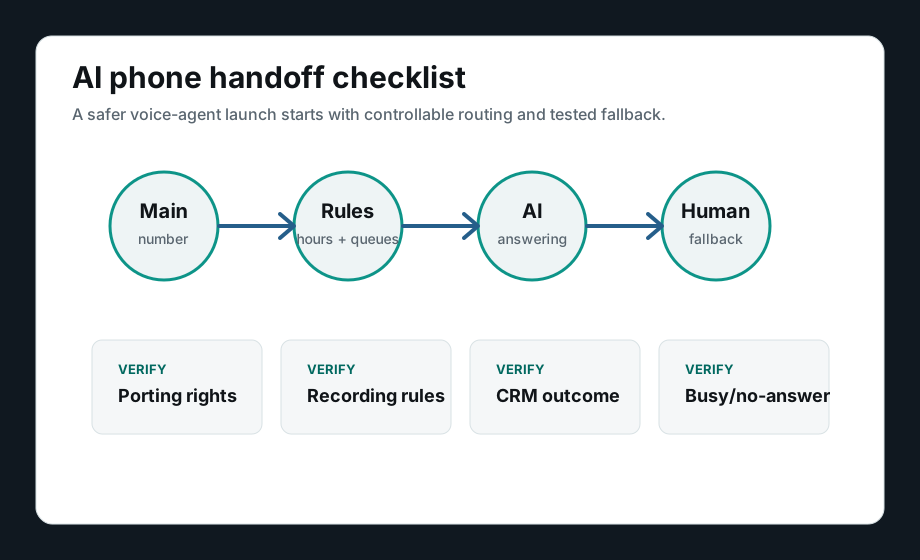
  • Test whether the AI or phone app can answer only the desired path: after-hours, overflow, missed call, or selected number.
  • Confirm what appears in call logs, summaries, transcripts, and team follow-up queues after a real call.
  • Verify whether the business can route urgent, sensitive, failed-tool, and low-confidence calls to a human.
  • Compare monthly subscription cost, AI add-ons, CRM integration needs, and implementation support before porting.
  • Document the rollback path if the new phone app does not handle caller ID, texts, voicemail, or transfer behavior correctly.

Implementation option

Need more than app-first AI answering?

Remote Partners AI can be evaluated when the buyer needs the phone provider, SIP path, LiveKit voice agent, CRM outcome, monitoring, fallback, and human escalation designed as one production workflow.

Scope the AI receptionist build
FAQ

FAQ

OpenPhone/Quo vs Google Voice questions

Is OpenPhone/Quo better than Google Voice for an AI receptionist?

OpenPhone/Quo is usually better when the team wants AI answering, call summaries, transcripts, and shared follow-up workflow. Google Voice is usually better when Workspace simplicity is the main requirement and the call path is basic.

Can Google Voice do AI answering like OpenPhone/Quo?

Google Voice has useful AI-assisted features such as spam blocking and voicemail transcription, but OpenPhone/Quo has a more direct AI answering and call-summary workflow for small teams.

Should I switch from Google Voice to OpenPhone/Quo before testing AI?

Only switch after testing the current call path and identifying the gap. If the gap is team ownership, summaries, transcripts, or follow-up workflow, OpenPhone/Quo is worth testing. If the gap is custom SIP or LiveKit routing, neither app may be enough.

When is neither OpenPhone/Quo nor Google Voice enough?

Neither is enough when the AI receptionist needs SIP/BYOC, PBX integration, LiveKit rooms, custom tool calls, advanced monitoring, compliance workflows, or detailed human transfer logic.