Call entry
Number control
Know who owns the number and how porting, forwarding, and failover will work.
Tool
Use this before buying a new phone system, porting numbers, or connecting an AI receptionist to an existing stack.
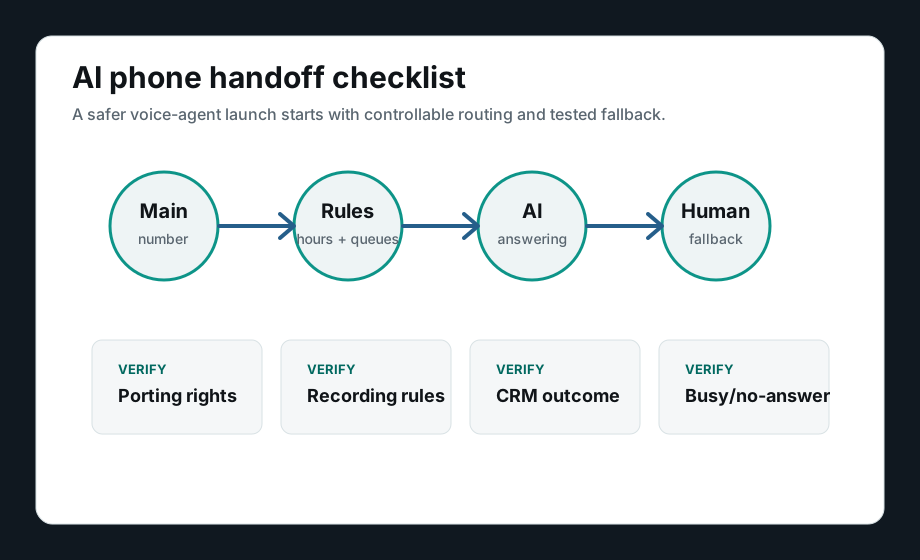
Direct answer
A VoIP system is ready for AI answering when the business controls the number, can route calls intentionally, can send calls to native AI, forwarding, SIP, or BYOC without breaking callers, and has tested human fallback.
Call entry
Know who owns the number and how porting, forwarding, and failover will work.
Call path
Map business hours, queues, overflow, departments, and escalation outcomes.
Call data
Decide when calls are recorded, summarized, stored, and passed to a CRM.
Recovery
Test busy, no-answer, offline, transfer failure, and voicemail paths before launch.
AI receptionists get messy when the business does not know who owns the main number or how calls can be redirected.
15 point weightThe fastest AI deployment path is often clean forwarding or overflow routing before deeper SIP work.
14 point weightSIP support opens more flexible AI agent architecture, carrier failover, and routing control.
15 point weightAI answers better when routing intents and human fallback paths are explicit.
12 point weightCapturing calls is not enough. The useful outcome is booked work, routed cases, or structured follow-up.
11 point weightLatency, jitter, packet loss, and SIP ALG issues can ruin both human and AI phone performance.
11 point weightVoice automation needs clear compliance boundaries before production launch.
11 point weightAn AI receptionist should reduce missed calls, not create a single fragile route.
11 point weightTechnical checks
FAQ
Often yes, if your current phone system supports clean forwarding, overflow routing, SIP, or another reliable external handoff. Complex call trees and weak number ownership make that harder.
Latency, jitter, packet loss, MOS, SIP ALG behavior, and concurrent call capacity matter because poor voice quality hurts both human callers and AI transcription or response quality.
Recording rules affect consent, retention, QA, compliance, and whether call summaries or transcripts can be stored or passed to a CRM or support workflow.
The fastest test is usually an after-hours, overflow, or no-answer forwarding route that sends a limited call path to AI while preserving the normal human path and fallback.
The call should route to a human, voicemail, callback workflow, ticket, or emergency fallback based on the caller intent and business rules. That fallback should be tested before launch.