
Direct answer
Twilio Jio India voice call failures carrier routing proof: what buyers need to know
Twilio's July 17-20, 2026 status page reported voice call failures from Twilio phone numbers to Reliance Jio network subscribers in India, with repeated updates saying the cause had been identified and work was continuing. IsDown independently archived the same incident timeline and region-specific updates for Andhra Pradesh, Maharashtra and Goa, Tamil Nadu, and Karnataka before later updates generalized the scope to Jio subscribers in India. VoIP buyers should treat this as a carrier-route proof problem: validate affected destinations, call-failure evidence, alternate carrier routing, retry rules, customer notices, SLA handling, and closure proof instead of assuming one CPaaS or SIP provider path is enough.
This brief cites the source announcement and translates the event into a buyer framework. Verify current vendor terms before changing phone, messaging, or AI routing.
What happened
- Twilio's public status page listed voice call failures from Twilio phone numbers to Reliance Jio network subscribers in India beginning July 17, 2026.
- Early Twilio updates named affected Reliance Jio regions including Andhra Pradesh, Maharashtra and Goa, Tamil Nadu, and Karnataka.
- Later July 18, July 19, and July 20 updates said Twilio had identified the cause and was continuing work to resolve the issue.
- IsDown independently archived the incident timeline, including investigation, identified states, and repeated continuing updates.
- Twilio's own troubleshooting documentation points users to Debugger and Request Inspector when voice calls fail or behave unexpectedly, which reinforces the need for call-path evidence rather than generic uptime claims.
Why this is trending
- A carrier-specific destination failure is more actionable for buyers than a broad outage headline because it exposes whether the phone stack monitors individual routes, networks, countries, and retry paths.
- AI voice agents, appointment setters, collections workflows, call centers, and support desks can all appear healthy while one destination network fails repeatedly.
- The multi-day update cadence makes this a continuity proof story: buyers need to know what evidence they will receive before, during, and after a carrier route problem.
The VoIP Stack Index take
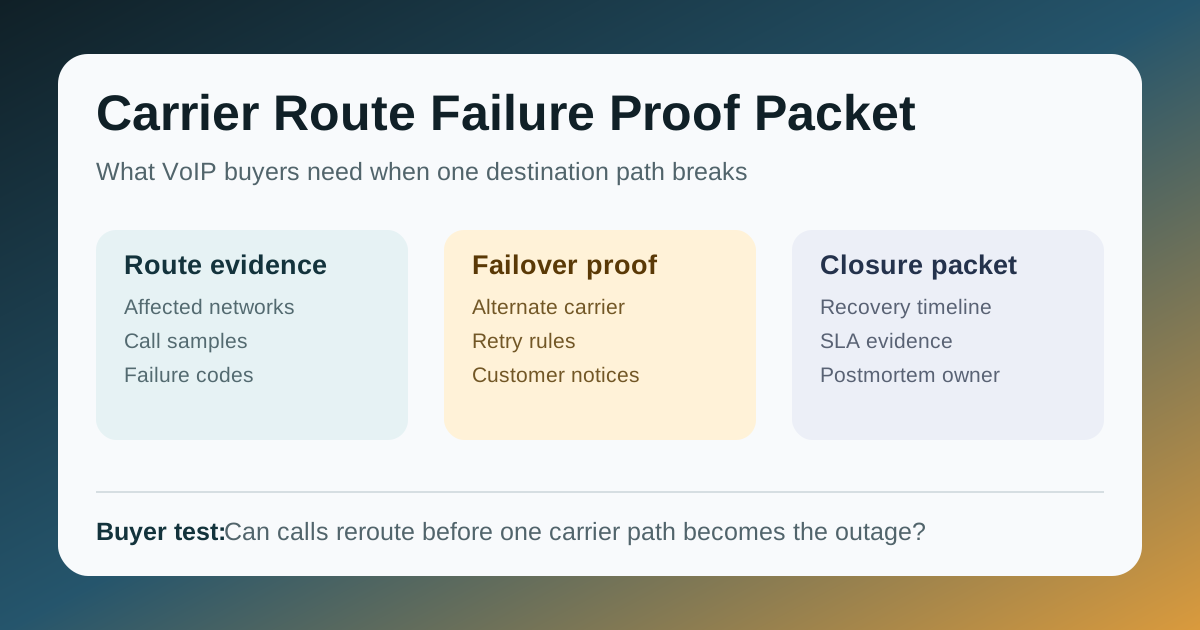
A VoIP buyer should not accept 'the provider is investigating' as the whole operating plan. The buyer needs a Carrier Route Failure Proof Packet: affected network scope, failed-call samples, SIP or API error evidence, alternate carrier routing, retry behavior, customer notice rules, SLA treatment, business-impact reporting, and post-incident closure proof.
Carrier Route Failure Proof Packet
A VoIP buyer framework for validating carrier-specific call failures across route monitoring, affected network scope, alternate carrier paths, customer impact, SLA handling, and incident closure.
What buyers should do next
Build a route-health dashboard by country, carrier, prefix, provider route, and critical voice workflow.
Collect failed-call samples with timestamps, source numbers, destinations, call IDs, SIP or API error codes, and retry outcomes.
Define which destination networks require alternate carrier paths before launch.
Test failover routing for contact-center, sales, collections, appointment, and AI voice-agent call paths.
Create customer notice, SLA, credit, and callback rules for carrier-specific degradation.
Close incidents only after successful retests, business-impact review, customer handling, and owner signoff.
Buyer bridge
Do the routing audit before buying the buzz.
The winning AI phone stack is the one that preserves context, controls fallback, and lets humans take over without making the customer repeat the story.
Run the AI-ready VoIP audit