Voice continuity proof

ThousandEyes Saw 509 Network Outages in One Week

The news is NetworkWorld's July 14, 2026 internet health report citing Cisco ThousandEyes data for July 6-12: 509 global network outage events, a 15% weekly increase, with U.S. outages up 27% and public cloud outages up sharply. The buyer issue is practical: VoIP, UCaaS, SIP trunking, CPaaS, contact-center, and AI voice teams need proof for ISP dependency, cloud-region risk, carrier failover, UCaaS fallback, alert ownership, and incident evidence before a normal week of internet volatility becomes missed calls.

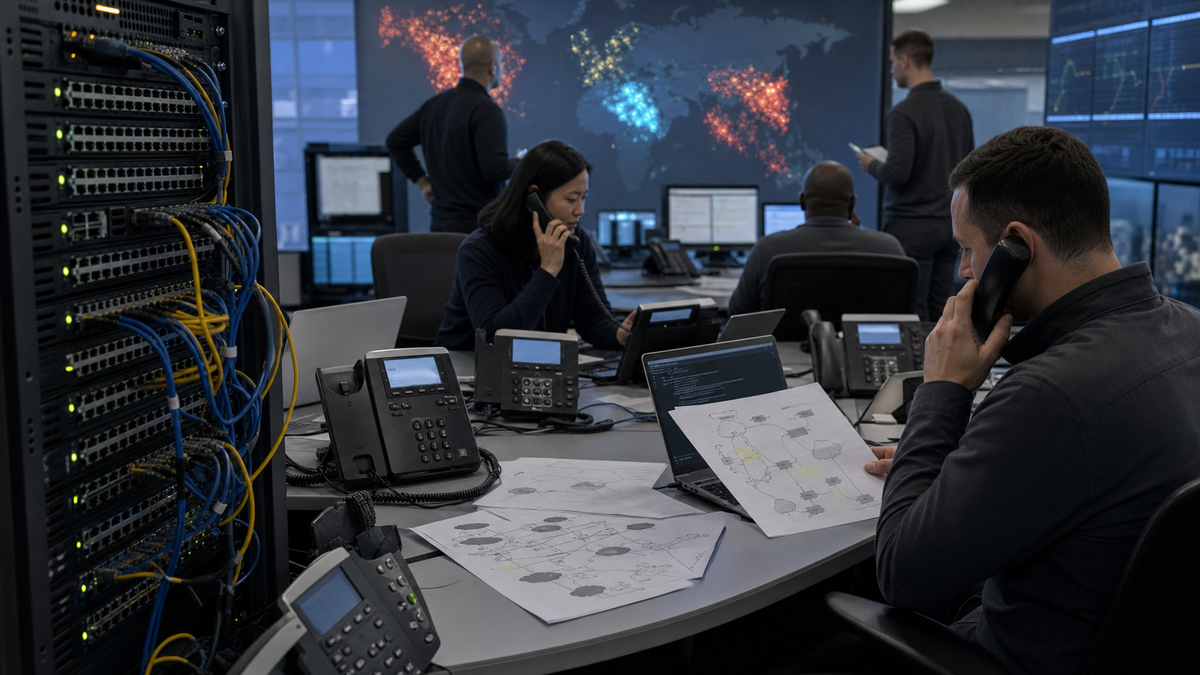
Synthetic editorial image of telecom operations staff reviewing unbranded network outage, cloud routing, and business voice continuity evidence.
Editorial image: synthetic representative telecom scene, not a photo of the named company or news event.

Direct answer

ThousandEyes 509 network outages July 2026 cloud voice continuity proof: what buyers need to know

NetworkWorld reported on July 14, 2026 that Cisco ThousandEyes counted 509 global network outage events during the week of July 6-12, up 15% from the prior week. The same report said U.S. outages rose to 377, up 27%, and public-cloud provider outages rose from 136 to 234 globally. VoIP buyers should treat the report as a continuity-proof trigger: verify how calls fail over when ISPs, public clouds, carriers, UCaaS platforms, or edge services degrade.

Published 7/15/2026 News event 7/14/2026

This brief cites the source announcement and translates the event into a buyer framework. Verify current vendor terms before changing phone, messaging, or AI routing.

What happened

  • NetworkWorld's July 14 internet health report cited Cisco ThousandEyes data for the week of July 6-12, 2026.
  • The report counted 509 global network outage events, up 15% from the prior week.
  • U.S. network outage events rose to 377, up 27% week over week.
  • Public-cloud provider outages rose from 136 to 234 globally, while U.S. public-cloud outages rose from 120 to 221.
  • NetworkWorld also noted that collaboration-app outages stayed at zero for a third consecutive week, which makes the buyer issue about dependencies around the app, not only the app itself.

Why this is trending

  • The story gives voice buyers a concrete weekly outage signal instead of a vague warning that cloud and network paths can fail.
  • Business calling now depends on layered infrastructure: office ISP, home ISP, SD-WAN, public cloud, UCaaS, SBCs, SIP trunks, carriers, CPaaS, AI voice tooling, and contact-center routing.
  • A collaboration app can stay up while the access path, cloud region, edge network, carrier handoff, or failover plan still breaks customer calls.

The VoIP Stack Index take

A VoIP buyer should not accept a generic uptime page as continuity proof. The buyer needs a Cloud Voice Continuity Proof Packet: ISP dependency map, public-cloud region list, carrier failover path, UCaaS fallback workflow, alert owner, status-notice process, and exportable incident evidence after packet loss, call failures, or routing degradation.

Cloud Voice Continuity Proof Packet

A buyer framework for validating business voice continuity across ISP dependency, cloud-region risk, carrier failover, UCaaS fallback, alert ownership, and incident evidence.
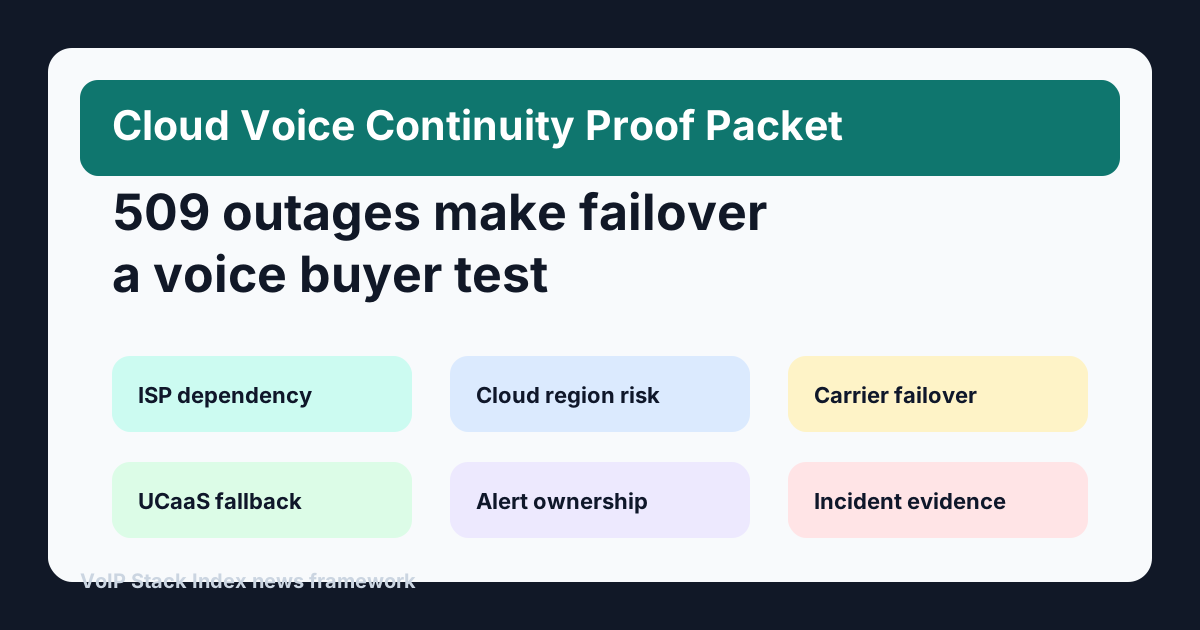
Cloud Voice Continuity Proof Packet framework visual
Channel AI fit Human rule VoIP requirement
ISP dependency Monitoring can correlate failed calls, packet loss, jitter, and unreachable sites with office, branch, or remote-worker ISP paths. A voice owner must know which users, queues, numbers, and sites lose calling when a specific access provider degrades. ISP inventory, site/user mapping, backup link, mobile fallback, packet-loss threshold, and support escalation route.
Cloud region risk Observability tools can detect whether voice control planes, media paths, AI services, storage, or analytics depend on one cloud region. Procurement and operations must verify region redundancy rather than assuming the vendor's cloud claim covers the call path. Region list, failover design, data residency rule, dependency map, recovery objective, and status-page evidence.
Carrier failover Routing analytics can flag carrier-specific failures, blocked destinations, abnormal answer rates, and retries by number group. A telecom owner must approve backup carrier routing before customers discover failed inbound or outbound calls. Primary and secondary carrier list, number portability constraints, reroute trigger, SIP response evidence, and test calls.
UCaaS fallback Automation can move queues to backup numbers, voicemail capture, SMS callback, or alternate receptionist coverage when voice routes fail. Fallback must preserve customer context and ownership rather than sending callers into an unmanaged mailbox. Backup IVR, emergency greeting, callback queue, SMS/email fallback, supervisor owner, and restoration playbook.
Alert ownership Network and voice alerts can be deduplicated, prioritized, and tied to affected queues, sites, phone numbers, and campaigns. A named person must decide when to change routing, notify teams, pause outbound campaigns, or trigger manual coverage. Alert thresholds, on-call owner, decision tree, notification list, campaign pause rule, and customer-facing status text.
Incident evidence Post-incident tooling can join CDRs, SIP responses, status events, monitoring probes, customer complaints, and recovery actions. Vendors should provide proof after the event, not only a verbal explanation that the internet had issues. Incident timeline, affected numbers, CDR sample, SIP ladder, monitoring export, customer impact count, and corrective action.

What buyers should do next

01

Map every provider in the live call path, including ISP, SD-WAN, UCaaS, SBC, SIP trunk, carrier, CPaaS, AI voice tool, and contact-center queue.

02

Ask vendors which public-cloud regions, edge networks, and carrier routes support your production traffic.

03

Run failover tests for inbound calls, outbound calls, queue routing, voicemail capture, SMS callback, and live-agent fallback.

04

Assign an alert owner who can reroute traffic, pause outbound campaigns, and notify operators during network degradation.

05

Require a post-incident evidence packet that includes CDRs, SIP responses, status timestamps, affected numbers, and final recovery actions.

Buyer bridge

Do the routing audit before buying the buzz.

The winning AI phone stack is the one that preserves context, controls fallback, and lets humans take over without making the customer repeat the story.

Run the AI-ready VoIP audit