
Direct answer
ThousandEyes 587 outage events cloud voice continuity map: what buyers need to know
Network World's July 21, 2026 ThousandEyes internet health check reported 587 global outage events across ISP, public-cloud, collaboration-app, and edge networks for the week of July 13-19. The same report said U.S. outage events reached 417, global ISP outages rose to 241, and public-cloud network outages rose to 274. VoIP buyers should treat the spike as a continuity proof test: ask for route telemetry, cloud dependency maps, alternate carrier and SIP paths, contact-center queue rules, AI voice-agent degradation controls, customer notice evidence, and incident closure proof.
This brief cites the source announcement and translates the event into a buyer framework. Verify current vendor terms before changing phone, messaging, or AI routing.
What happened
- Network World reported on July 21, 2026 that Cisco ThousandEyes observed 587 global outage events for the week of July 13-19 across ISP, public-cloud, collaboration-app, and edge networks.
- The report said U.S. outage events increased to 417 for the same week.
- Global ISP outage events rose to 241 and public-cloud network outage events rose to 274 in the weekly roundup.
- The report also noted one collaboration-app network outage event after zero in the previous week.
- For phone-system buyers, the practical issue is not the headline count alone. It is whether a cloud voice stack can prove which routes, queues, providers, and voice agents remain usable when internet paths degrade.
Why this is trending
- The outage count arrived as more business voice, contact-center, UCaaS, SIP trunking, and AI calling workflows depend on public internet and cloud-provider paths.
- Weekly internet health spikes are easy to dismiss until they hit a specific call route, meeting path, queue, or provider region that the business depends on.
- Buyers increasingly need evidence that voice continuity is tested across carrier routing, cloud dependencies, and customer notification, not only promised in uptime language.
The VoIP Stack Index take
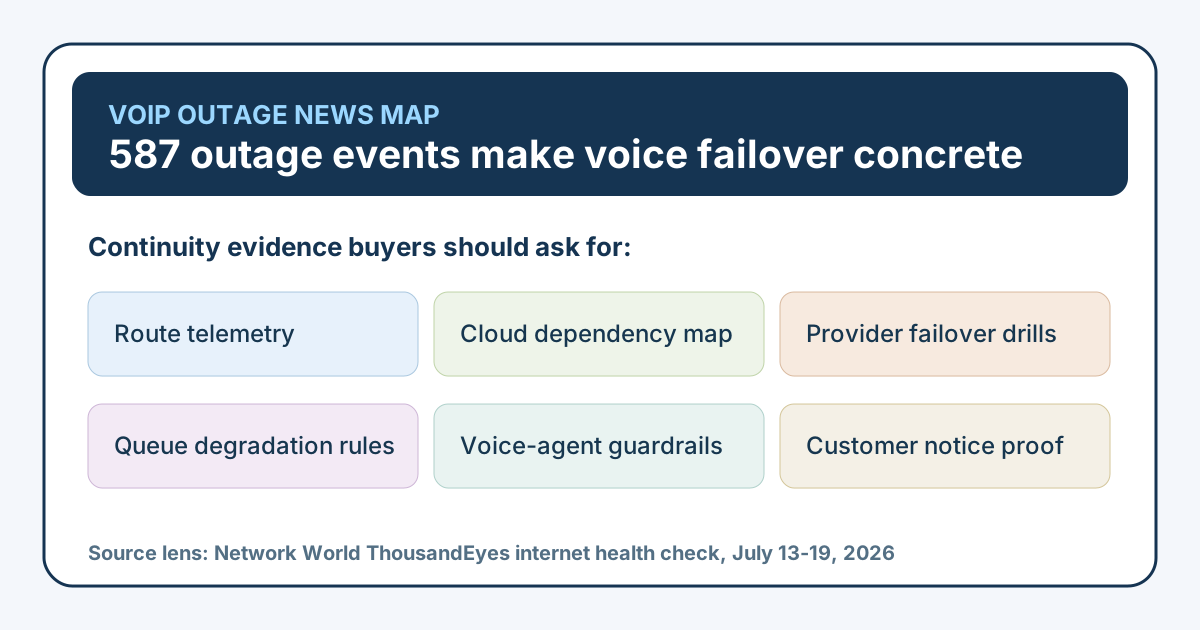
A VoIP buyer should use the ThousandEyes spike as a route-level readiness test. The required packet is a Cloud Voice Continuity Proof Map: provider dependency inventory, route-level telemetry, failover drills, queue degradation rules, AI voice-agent fallback behavior, customer notice triggers, and closure evidence after the network event.
Cloud Voice Continuity Proof Map
A VoIP buyer framework for validating outage continuity across route-level telemetry, cloud dependencies, alternate provider paths, contact-center queues, AI voice-agent guardrails, customer notices, and closure proof.
What buyers should do next
List every public internet, cloud, SIP, CPaaS, UCaaS, and contact-center dependency behind business calling.
Compare outage telemetry against call-completion, media-quality, failed-transfer, and callback data by route.
Run a failover test for the highest-value inbound and outbound voice workflows.
Document which customer notices, queue changes, and AI voice-agent fallbacks trigger during route degradation.
Use the AI-ready VoIP audit to turn continuity claims into evidence before the next weekly outage spike reaches customers.
Buyer bridge
Do the routing audit before buying the buzz.
The winning AI phone stack is the one that preserves context, controls fallback, and lets humans take over without making the customer repeat the story.
Run the AI-ready VoIP audit