
Direct answer
Telstra NTP outage Senate voice continuity proof: what buyers need to know
Telstra's July 17, 2026 Senate evidence turned its national outage into a voice-continuity proof case. ABC News reported Telstra linked the outage to the same software configuration and said a solution was in place by 10:38am on July 9. The Guardian reported Telstra had not applied manufacturer software updates flagged in 2022 and January 2026, and that one of three NTP servers reset to 2006 before downstream systems accepted the bad date. ACMA said the issue caused intermittent voice and data disruptions and was engaging stakeholders including the Triple Zero Custodian. VoIP buyers should respond by proving time-source inventory, patch history, clock-drift controls, failover paths, emergency-call evidence, claims handling, and closure tests.
This brief cites the source announcement and translates the event into a buyer framework. Verify current vendor terms before changing phone, messaging, or AI routing.
What happened
- ABC News reported on July 17, 2026 that Telstra told a Senate inquiry the outage was linked to the same software configuration and that a solution was implemented at 10:38am on July 9.
- The Guardian reported Telstra said a network time protocol server reset to 2006 and that downstream systems accepted the wrong date information.
- The Guardian also reported the manufacturer had warned Telstra in 2022 and January 2026 to apply a software update that may have avoided the outage.
- The Guardian reported Telstra connected 58,835 triple-zero calls during the outage period, while 604 errors were recorded, and that about 8,000 customer claims had led to about $100,000 paid.
- ACMA said the issue caused intermittent voice and data disruptions and that it was engaging with stakeholders including the Triple Zero Custodian.
Why this is trending
- The Senate evidence moved the Telstra story from a general outage into an auditable proof problem around network timing, missed updates, emergency-call exposure, and customer redress.
- A time-source failure is easy to underestimate because it does not look like a phone feature, but voice platforms, authentication, billing, routing, monitoring, and emergency workflows can all depend on trusted time.
- The emergency-call and claims details make the story buyer-relevant: leaders need evidence of who was affected, which call paths failed, what was fixed, and how the system was retested.
The VoIP Stack Index take
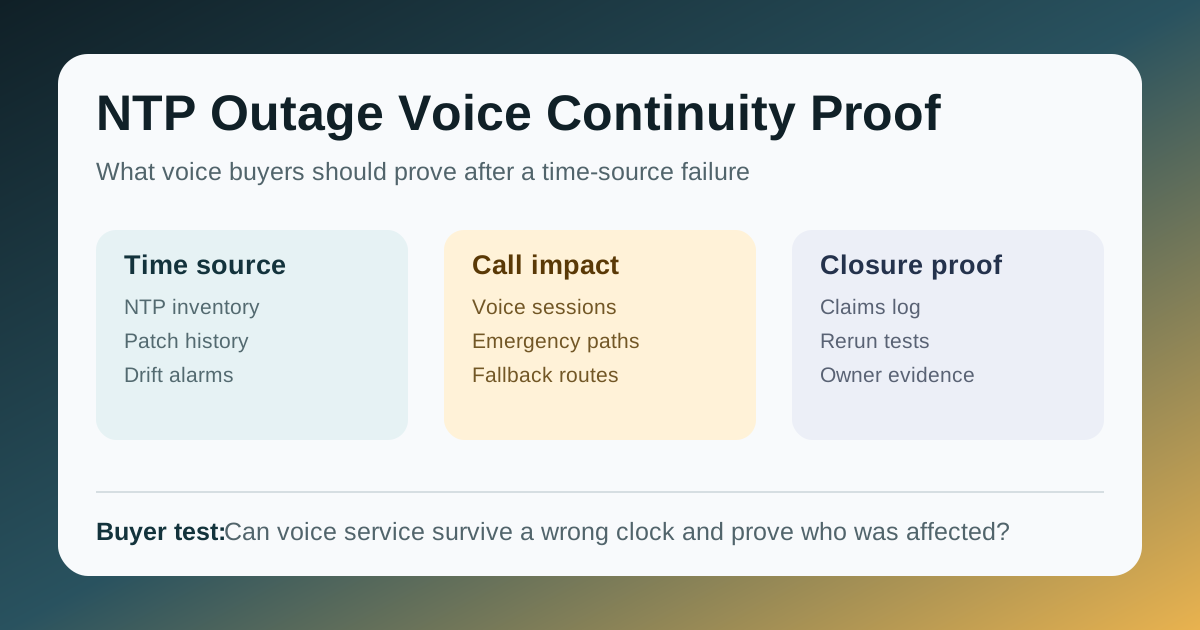
A VoIP buyer should not accept 'the outage is fixed' without continuity evidence. The buyer needs an NTP Outage Voice Continuity Proof Map: authoritative time-source inventory, update and firmware history, drift alarms, downstream acceptance rules, affected voice-session analysis, failover routing tests, emergency-call evidence, claims handling, and closure proof.
NTP Outage Voice Continuity Proof Map
A buyer framework for validating voice continuity across time-source inventory, software-update proof, clock-drift alarms, voice-session impact, emergency routing, failover, claims, and incident closure.
What buyers should do next
Inventory every NTP, GPS, timing, SBC, PBX, UCaaS, SIP, monitoring, and emergency-routing dependency in the voice path.
Compare each timing dependency with current vendor advisories, software versions, firmware versions, and deferred-update exceptions.
Add drift, jump, peer-disagreement, and historical-date rejection tests for voice-critical systems.
Run failover and emergency-path test calls after any time-source or routing change.
Keep customer-impact analysis, claims handling, closure evidence, and owner signoff in the incident packet.
Buyer bridge
Do the routing audit before buying the buzz.
The winning AI phone stack is the one that preserves context, controls fallback, and lets humans take over without making the customer repeat the story.
Run the AI-ready VoIP audit