Direct answer
T-Mobile outage SOS mode voice continuity proof packet: what buyers need to know
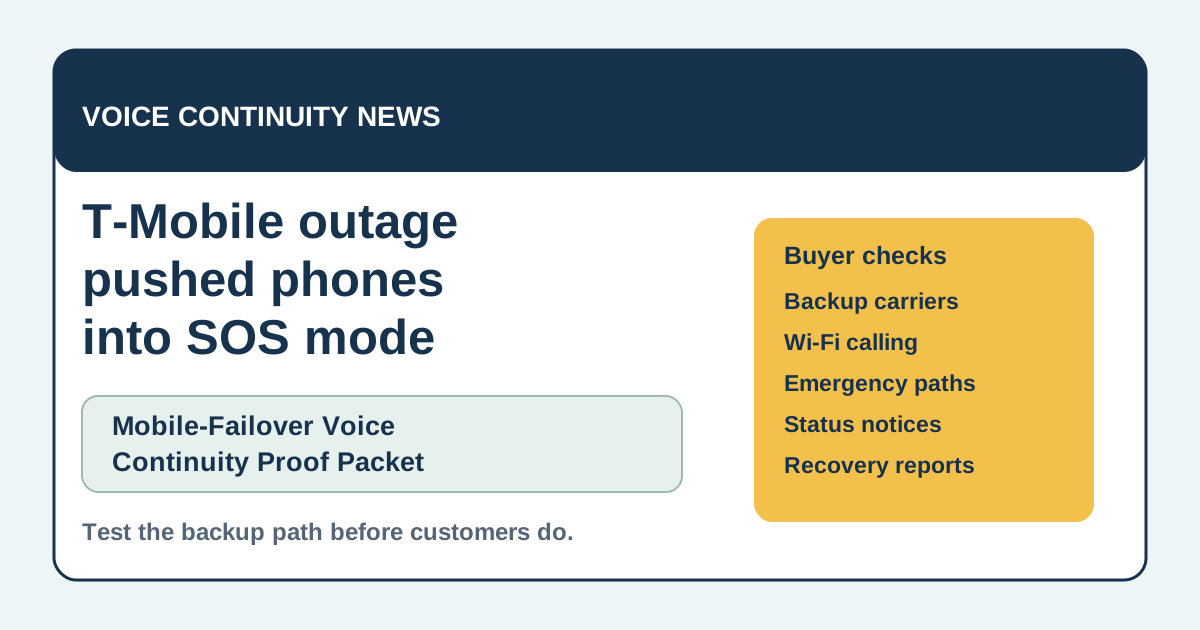
T-Mobile users reported a nationwide outage on July 27, 2026, with more than 62,000 Downdetector reports and some phones falling into SOS or SOS Only mode. T-Mobile later said service was restored, but public coverage did not identify a cause. VoIP buyers should treat the incident as a mobile-failover test: require proof that business voice keeps working across backup carriers, Wi-Fi calling, fixed-line routes, emergency paths, status notices, synthetic test calls, and customer recovery.
This brief cites the source announcement and translates the event into a buyer framework. Verify current vendor terms before changing phone, messaging, or AI routing.
What happened
- Tom's Guide tracked a July 27 T-Mobile outage with reports from major cities and customers saying phones were stuck in SOS or SOS Only mode.
- Times of India reported more than 62,000 Downdetector incidents at peak and said T-Mobile later stated that service had been restored.
- The same coverage explained that SOS mode means a phone cannot reach the normal carrier network but may still be able to place emergency calls through another available network.
- Public coverage did not provide a definitive outage cause at the time of restoration.
- The operational effect was broad enough to create customer confusion across mobile calls, data access, and recovery expectations.
- For business voice buyers, the same failure mode can affect staff mobiles, app-based calling, backup hotspots, SMS/MFA, field escalation, and after-hours routing.
Why this is trending
- The story had clear consumer momentum: tens of thousands of reports and visible SOS-mode symptoms on customer phones.
- Mobile service is now part of business voice continuity, not only a personal-device issue. Teams use mobile networks for softphones, MFA, failover hotspots, field service, after-hours escalation, and executive contact paths.
- The cause was not disclosed in early restoration coverage, which makes buyer evidence more important than generic uptime promises.
- The outage follows a run of carrier, cloud, and collaboration-platform incidents that make failover proof a procurement requirement for VoIP and UCaaS buyers.
The VoIP Stack Index take
A VoIP buyer should not assume cloud phone service is resilient because the app runs on many devices. If the backup path uses the same mobile carrier for staff phones, hotspot internet, SMS verification, and escalation contacts, one wireless outage can remove several recovery lanes at once. Ask providers and internal telecom owners for a Mobile-Failover Voice Continuity Proof Packet before relying on mobile as the safety net.
Mobile-Failover Voice Continuity Proof Packet
A VoIP buyer framework for validating business voice continuity when a mobile carrier outage affects staff phones, softphones, MFA, field teams, backup internet, emergency contacts, and customer updates.
What buyers should do next
Inventory every business voice workflow that depends on a mobile carrier, including softphones, staff mobiles, hotspots, MFA, SMS alerts, and field escalation.
Verify whether backup phones, eSIMs, hotspots, and executive contacts use a second carrier rather than the same hidden network.
Run proof calls across Wi-Fi calling, browser softphone, fixed broadband, desk phone, alternate SIP trunk, voicemail, IVR, and supervisor transfer routes.
Create non-SMS authentication fallback for administrators and support leaders who must operate during a carrier outage.
Prepare customer-status language that separates carrier outage facts from internal VoIP routing and support availability.
Use the VoIP Stack Index AI-ready VoIP audit and VoIP cost calculator to convert mobile-failover proof into buying requirements.
Buyer bridge
Do the routing audit before buying the buzz.
The winning AI phone stack is the one that preserves context, controls fallback, and lets humans take over without making the customer repeat the story.
Run the AI-ready VoIP audit