Direct answer
Starlink Mobile direct to cell voice route continuity proof packet: what buyers need to know
Business Insider reported that SpaceX is positioning Starlink Mobile to compete more directly with AT&T, Verizon, and T-Mobile, with next-generation satellites expected in 2027 and a larger spectrum position tied to EchoStar. MarketWatch reported that major wireless-carrier shares fell after SpaceX executives discussed the strategy, and Fierce Network covered the current direct-to-device architecture and expected 65 MHz spectrum position. VoIP buyers should treat the story as carrier route sovereignty proof: validate which calls can actually move across wireless, satellite, SIP, UCaaS, and mobile failover paths before treating satellite mobile as continuity.
This brief cites the source announcement and translates the event into a buyer framework. Verify current vendor terms before changing phone, messaging, or AI routing.
What happened
- Business Insider reported that SpaceX said it plans to turn Starlink Mobile into a broader mobile-carrier competitor.
- The report tied the next major Starlink Mobile upgrade to next-generation satellites expected in 2027 and spectrum acquired from EchoStar.
- MarketWatch independently reported that AT&T, Verizon, and T-Mobile shares fell after SpaceX executives discussed the Starlink Mobile strategy.
- Fierce Network reported that Starlink's current direct-to-device service operates on about 5 MHz through local telco providers and that the EchoStar deal would give it 65 MHz.
- T-Mobile's T-Satellite page shows the current commercial buyer reality: satellite service is useful, but service may be delayed, limited, or unavailable and depends on compatible devices and outdoor sky visibility.
- The buyer issue is not whether SpaceX wins carrier share. It is whether business calling continuity can be proven across changing carrier paths.
Why this is trending
- The story moved markets and generated coverage from investor, telecom, and technology outlets.
- It is a rare telecom story that affects both consumer wireless strategy and enterprise voice-continuity planning.
- Direct-to-cell and satellite mobile are moving from emergency text fallback toward broader voice and data ambition, which changes how buyers think about dead zones and mobile-first teams.
- Carrier disruption headlines can tempt buyers to overtrust a future service before E911, indoor coverage, queue routing, caller ID, recording, CRM logging, and recovery workflows are proven.
The VoIP Stack Index take
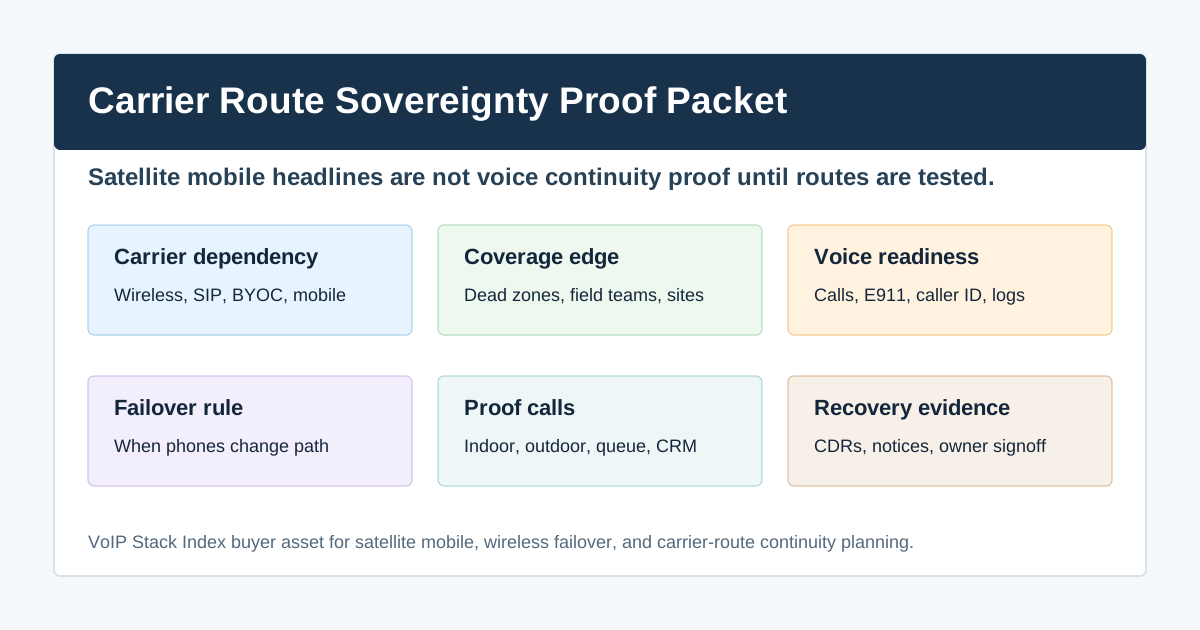
A VoIP buyer should not treat satellite mobile as a magic backup route or dismiss it as consumer hype. Ask for a Carrier Route Sovereignty Proof Packet showing which users, numbers, queues, devices, sites, and emergency scenarios depend on wireless carriers; when calls can fail over; how caller ID and E911 behave; which proof calls passed; and what CDR or incident evidence closes the loop.
Carrier Route Sovereignty Proof Packet
A VoIP and UCaaS buyer framework for validating carrier route dependency as satellite mobile, wireless failover, SIP, BYOC, E911, caller ID, proof calls, and recovery evidence converge.
What buyers should do next
Inventory public numbers, queue DIDs, SIP trunks, mobile devices, BYOC routes, wireless carriers, satellite-capable devices, and field-team locations.
Separate satellite texting, mobile data, and real voice calling requirements instead of using one generic backup-connectivity label.
Run proof calls across desk phones, mobile devices, outdoor locations, queues, voicemail, recording, caller ID, CRM logging, and callback paths.
Validate E911, location, callback, recording, and compliance behavior before satellite or mobile fallback is used for critical workflows.
Prepare customer notices and IVR copy for route degradation without overpromising emergency or indoor satellite performance.
Use the VoIP Stack Index AI-ready VoIP audit and VoIP cost calculator to turn carrier-route sovereignty into buying requirements.
Buyer bridge
Do the routing audit before buying the buzz.
The winning AI phone stack is the one that preserves context, controls fallback, and lets humans take over without making the customer repeat the story.
Run the AI-ready VoIP audit