
Direct answer
Spectrum Buncombe County fiber cut phone continuity proof packet: what buyers need to know
WLOS reported that a large-scale Spectrum fiber cut disrupted phone service and county services in Buncombe County, North Carolina on August 4, 2026, while 911 was not affected and Buncombe County Government phones were restored at 4:05 p.m. Spectrum later said vandals pulled wires down from a utility pole near London Road. VoIP buyers should treat the event as fiber-cut continuity proof: require affected-service scope, carrier-path evidence, fallback numbers, 911 separation, proof calls, customer notices, and recovery reporting.
This brief cites the source announcement and translates the event into a buyer framework. Verify current vendor terms before changing phone, messaging, or AI routing.
What happened
- WLOS reported that a Spectrum outage caused by a large-scale fiber cut disrupted phone service and county services in Buncombe County on August 4, 2026.
- Buncombe County said 911 service was not impacted, while county phones and services were affected.
- WLOS reported that Buncombe County Government phones were restored as of 4:05 p.m.
- Spectrum said the outage was caused by a criminal attack in which vandals pulled wires down from a utility pole near London Road.
- Fox Carolina independently reported the outage, restoration time, and Spectrum vandalism statement.
- WYFF also covered the outage and reported that the fiber cut affected access to county phones and services.
Why this is trending
- The story had same-day local reporting, county-service impact, and independent coverage from multiple regional outlets.
- It exposed a common buyer blind spot: public-facing phones can be degraded by a physical access-network event even when emergency service remains separated.
- Spectrum's statement tied the event to infrastructure vandalism, a broader risk category that telecom buyers cannot treat as rare edge-case planning.
- The outage affected phone access, not just generic internet browsing, which makes it relevant to call centers, municipalities, healthcare desks, field service teams, and after-hours support.
The VoIP Stack Index take
A VoIP buyer should not accept a provider uptime page or a working internal test call as continuity proof. Ask the provider and telecom owner for a Fiber Cut Voice Continuity Proof Packet showing which services failed, which phones and sites were affected, how 911 was separated, which alternate numbers or mobile routes worked, what customers were told, and which proof calls closed the incident.
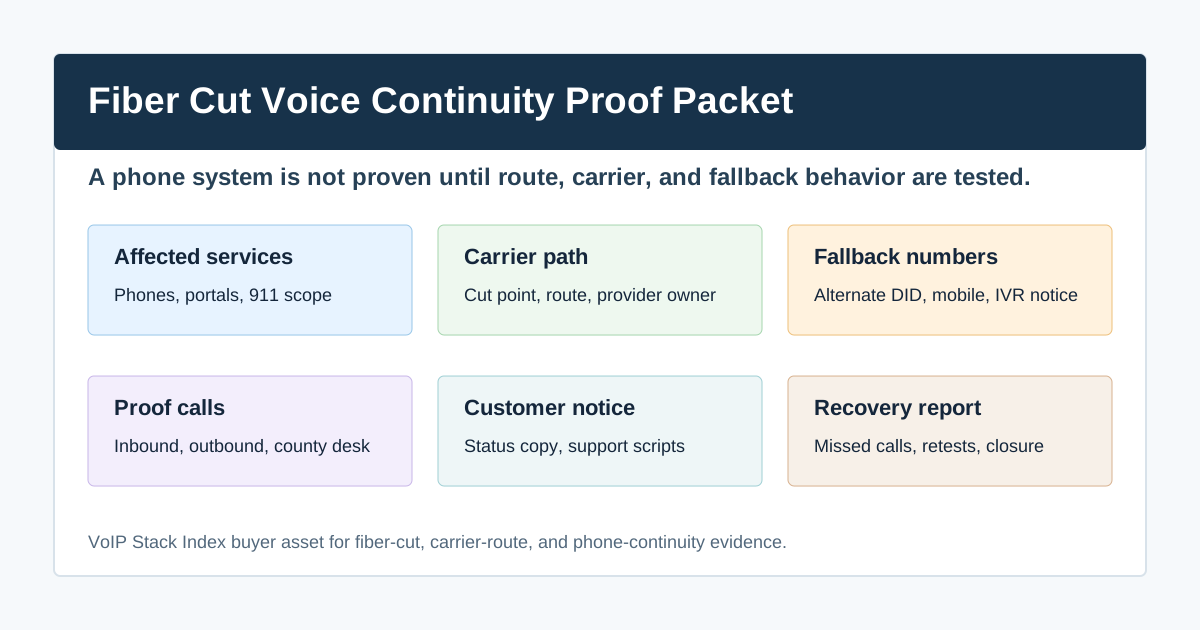
Fiber Cut Voice Continuity Proof Packet
A VoIP and UCaaS buyer framework for validating phone continuity across affected services, carrier paths, fallback numbers, 911 scope, proof calls, customer notices, and recovery evidence.
What buyers should do next
Map public phone numbers, desk phones, IVR paths, emergency-service dependencies, internet circuits, SIP trunks, and fallback numbers by site.
Run proof calls from representative mobile and landline carriers to public numbers, queues, desk phones, voicemail, and backup contact paths.
Confirm whether 911, alarm lines, elevator phones, dispatch numbers, after-hours lines, and regulated contacts share the same access risk.
Prepare outage copy that tells customers how to reach the business without overstating emergency-service impact.
Create a recovery queue for missed calls, failed callbacks, abandoned service requests, and customer complaints during the disruption window.
Use the VoIP Stack Index AI-ready VoIP audit and VoIP cost calculator to convert fiber-cut continuity proof into buying requirements.
Buyer bridge
Do the routing audit before buying the buzz.
The winning AI phone stack is the one that preserves context, controls fallback, and lets humans take over without making the customer repeat the story.
Run the AI-ready VoIP audit