
Direct answer
Optus Triple Zero outage voice continuity proof packet: what buyers need to know
The Optus outage is a voice-continuity proof event for business-phone buyers. Reuters reported a 76-minute technical glitch that disrupted voice calling and some emergency-services calls across several Australian states and territories, with police welfare checks after affected emergency-call attempts. Buyers should ask providers for an Emergency Call Continuity Proof Packet covering emergency-call scope, failover behavior, monitoring, affected-number discovery, user notices, welfare-check handoff and post-incident closure.
This brief cites the source announcement and translates the event into a buyer framework. Verify current vendor terms before changing phone, messaging, or AI routing.
What happened
- Reuters reported that Optus apologised on September 12, 2026 after an outage the previous day affected users across several Australian states and disrupted some emergency-services calls.
- The report said the technical glitch lasted 76 minutes and affected voice calling in parts of Victoria, South Australia, Tasmania and the Northern Territory.
- Reuters reported that Victoria Police completed around 40 welfare checks for callers affected by the outage and said there were no adverse outcomes or issues of note.
- Local Australian coverage reported broader customer impact and said police in multiple jurisdictions conducted welfare checks after emergency calls failed or were affected.
- The outage followed earlier Optus emergency-call problems, including a 2025 incident that drew regulatory and public scrutiny.
- Australia's communications regulator ACMA had already taken legal action in 2026 over the September 2025 Optus Triple Zero outage, keeping emergency-call reliability in the public eye.
Why this is trending
- Emergency calling is a high-trust voice workflow; even a short outage can trigger welfare checks, public attention and regulator questions.
- The story is not only about one mobile carrier. It shows why buyers of hosted VoIP, SIP trunks, contact centers and mobile failover should document what happens when a voice path breaks.
- Hybrid teams rely on softphones, mobile apps, desk phones, call forwarding, internet circuits and carrier routing that may fail in different ways.
- Emergency-call continuity cannot be proven by a generic uptime claim; it needs location, callback, alternate route, alerting, communication and closure evidence.
- Prior Optus emergency-call incidents make the September 2026 outage part of an ongoing reliability and notification story, not a one-off status-page event.
The VoIP Stack Index take
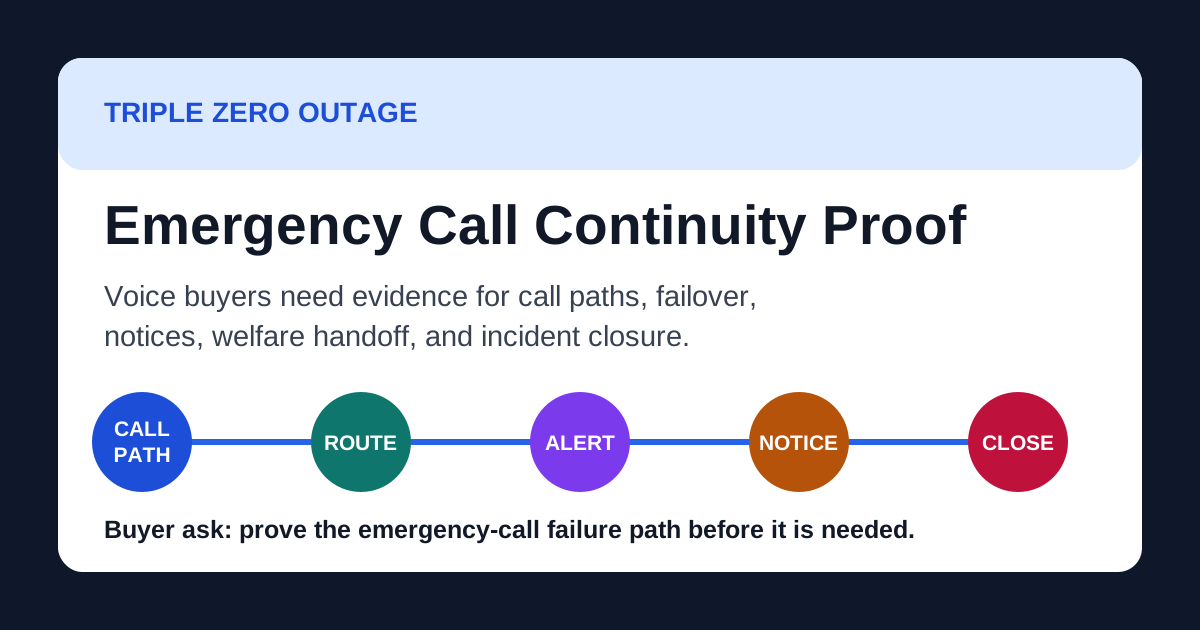
A VoIP buyer should not ask only whether the provider has high uptime. Ask for an Emergency Call Continuity Proof Packet that shows which users and locations can call emergency services, how failures are detected, what alternate routes exist, who receives alerts, how users are told what to do, and what evidence closes the incident afterward. The goal is not to promise that outages never happen. The goal is to prove that the failure path is known before someone needs it.
Emergency Call Continuity Proof Packet
A VoIP buyer framework for validating emergency-call assumptions, alternate routing, monitoring alerts, user notices, welfare-check handoff, regulator notifications and incident closure.
What buyers should do next
Ask each provider to list the exact endpoints, numbers and locations covered by emergency-calling records.
Confirm approved ways to test emergency-call location, callback and failover assumptions before an outage.
Document alternate contact paths for branches, remote users, contact centers and after-hours teams.
Define who receives voice-path alerts and when an outage becomes emergency-call relevant.
Keep a closure packet with affected routes, user notices, welfare handoff rules, retest evidence and open risks.
Buyer bridge
Do the routing audit before buying the buzz.
The winning AI phone stack is the one that preserves context, controls fallback, and lets humans take over without making the customer repeat the story.
Run the AI-ready VoIP audit