
Direct answer
Mitel MiVoice Office 250 end of technical support June 30 2026: what buyers need to know
Mitel MiVoice Office 250 reaches its June 30, 2026 technical-support deadline, according to lifecycle materials referenced by Mitel partners and Mitel's own migration guidance for Office 250 customers. Businesses still running the platform should treat the date as a continuity trigger, not a simple upgrade reminder. Before moving to VoIP, UCaaS, or a replacement PBX, buyers need proof that numbers, trunks, emergency calling, devices, call recording, paging, alarms, and rollback work.
This brief cites the source announcement and translates the event into a buyer framework. Verify current vendor terms before changing phone, messaging, or AI routing.
What happened
- Mitel's Office 250 replacement guidance says MiVoice Office 250 customers have alternatives and that Mitel announced the end-of-life process for the platform.
- Lifecycle summaries from Mitel partners list June 30, 2026 as the end of technical support for MiVoice Office 250, after earlier end-of-sale and end-of-software-design milestones.
- A lifecycle announcement PDF circulated by Mitel partners lists MiVoice Office 250 end of technical support and end of life on June 30, 2026.
- Mitel's product release lifecycle policy defines the broader support model buyers should use when judging whether a product is still current, supported, or ready for migration.
- The deadline lands on the same business day this article is published, making it a current migration and continuity check for organizations that waited until support expired.
Why this is trending
- MiVoice Office 250 and its Inter-Tel/ShoreTel lineage are still present in many small and mid-sized business phone closets.
- End-of-support risk becomes operational when the next failed controller, trunk issue, desk-phone problem, recording gap, or emergency-call change needs vendor help that may no longer be available.
- The deadline pushes buyers toward VoIP, UCaaS, SIP trunk replacement, or newer hybrid PBX options, all of which can break legacy devices if migration proof is weak.
The VoIP Stack Index take
A business should not replace Office 250 by shopping for a cheaper monthly phone seat alone. The buyer needs a migration proof packet: line inventory, number ownership, SIP readiness, E911 addresses, desk-phone and paging decisions, call-recording retention, analog device handling, failover routing, and a rollback window.
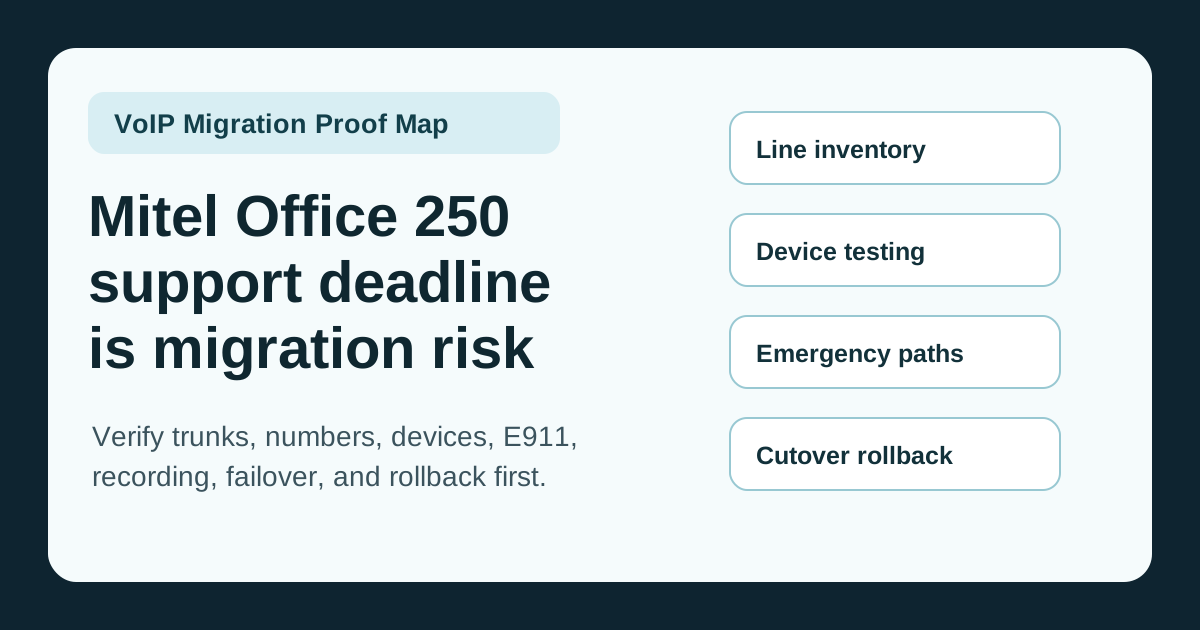
Office 250-to-VoIP Migration Proof Map
A buyer framework for validating phone numbers, SIP trunks, desk phones, paging, fax, alarms, call recording, E911, carrier failover, and rollback before replacing an unsupported Mitel Office 250 system.
What buyers should do next
Build a current Office 250 line, extension, device, trunk, and location inventory before buying replacement seats.
Mark every critical workflow: customer calls, emergency paths, paging, alarm, fax, elevator, gate, payment, after-hours, and recorded calls.
Ask providers for porting proof, E911 behavior, analog-device handling, recording export, call-quality testing, carrier failover, and rollback steps.
Run a staged cutover with test calls, device checks, recording checks, and a rollback window before decommissioning the old phone system.
Buyer bridge
Do the routing audit before buying the buzz.
The winning AI phone stack is the one that preserves context, controls fallback, and lets humans take over without making the customer repeat the story.
Run the AI-ready VoIP audit