
Direct answer
Microsoft Teams Phone Agent Frontier Public Preview AI attendant incoming calls: what buyers need to know
Microsoft's Teams Phone Agent is an AI-enabled Teams Phone voice application now available through the Frontier Public Preview program. Microsoft Learn says it extends auto attendants with conversational call screening, question answering, appointment management, routing, Copilot Studio integration, and transfers to queues or people. VoIP buyers should treat the preview as a routing-proof trigger, not a reason to replace IVR, reception, or call-queue design without testing.
This brief cites the source announcement and translates the event into a buyer framework. Verify current vendor terms before changing phone, messaging, or AI routing.
What happened
- Microsoft's June 2026 Teams update described Teams Phone Agent as a new AI experience for answering incoming calls to a Teams Phone service line, handling common questions, scheduling appointments, and routing callers.
- Microsoft Learn says Teams Phone Agent is currently available only to customers in the Frontier Public Preview program.
- The setup docs list June 15 as the preview entry point and June 22 as the availability date for historical reporting V0.01.
- Microsoft's planning docs say Teams Phone Agents extend auto attendants with AI-driven conversations that can screen calls, answer questions, manage appointments, route callers, and integrate with Copilot Studio for specialized workflows.
- The Q&A tool documentation adds practical limits buyers must understand, including file-size limits, public-URL handling, no automatic web rescans during preview, and guidance to avoid conflicting knowledge articles.
Why this is trending
- Teams Phone is already embedded in many Microsoft 365 environments, so putting an AI attendant into the phone layer can affect reception, call queues, appointment booking, branch lines, and customer-service routing.
- The preview shifts AI voice from a separate CCaaS buying decision into the Microsoft phone stack, where many buyers assume calling is already covered by existing licenses.
- The documentation is specific enough to matter operationally: it names preview access, Q&A tools, appointment tools, Copilot Studio handoff, call routing, historical reporting, and knowledge-source limits.
The VoIP Stack Index take
A VoIP buyer should not approve AI phone answering just because the tenant already uses Teams. The buyer needs a routing proof map: which lines the agent answers, what knowledge it can use, how appointments are confirmed, when callers reach a person, how reporting catches failed interactions, and what happens if the preview feature changes or is unavailable.
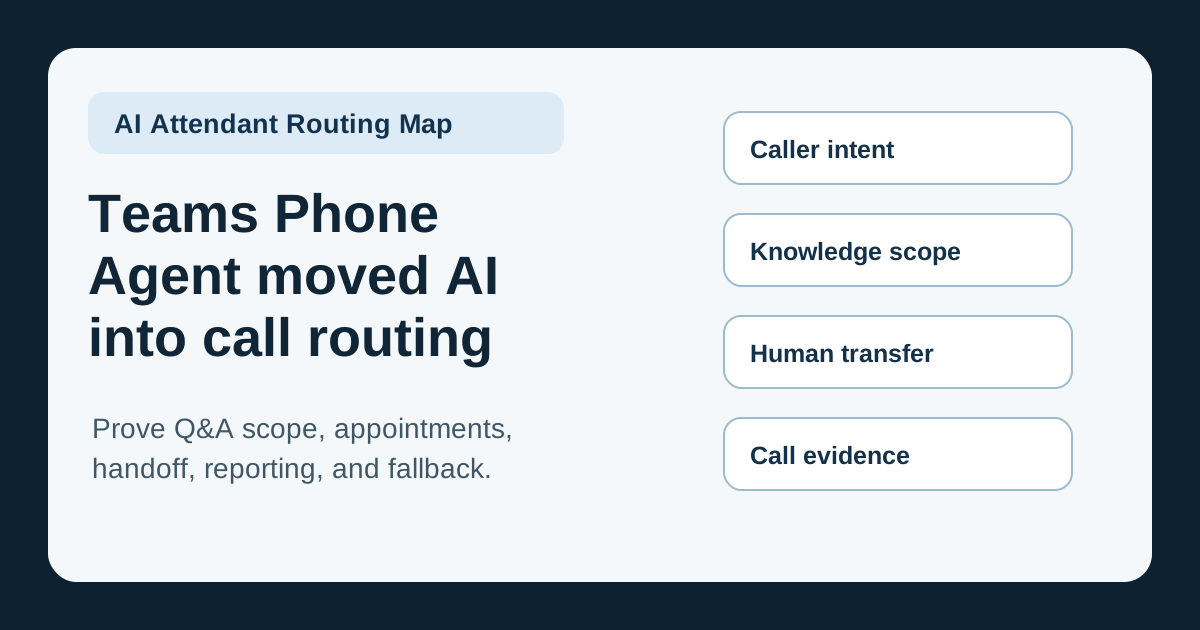
AI Attendant Routing Proof Map
A buyer framework for validating AI phone attendants across caller intent, Q&A scope, appointments, queue transfer, call history, reporting, human fallback, and carrier continuity.
What buyers should do next
List the phone numbers, service lines, branches, departments, and reception paths that could be affected by Teams Phone Agent.
Separate call types that are safe for AI self-service from calls that need a person, queue, emergency path, or external number.
Review Q&A source documents and public URLs for accuracy, conflict, size limits, update ownership, and caller-safe language.
Run test calls for common questions, appointment flows, after-hours behavior, transfers, queue overflow, callback requests, and failure recovery.
Ask providers for a routing proof packet with reporting evidence, preview limitations, fallback design, human-owner rules, and rollback steps.
Buyer bridge
Do the routing audit before buying the buzz.
The winning AI phone stack is the one that preserves context, controls fallback, and lets humans take over without making the customer repeat the story.
Run the AI-ready VoIP audit