
Direct answer
Microsoft Teams APAC outage VoIP continuity proof packet: what buyers need to know
Microsoft Teams had a July 24, 2026 Asia-Pacific outage that affected meetings and calls. ABC reported Microsoft said users could not join or create Teams meetings or calls and that Downdetector showed more than 7,000 reports. IsDown's Microsoft 365 incident mirror listed affected scenarios including 1:1 calling, group calling, meeting join, meeting scheduling, transcriptions, and PSTN calls. VoIP buyers should treat the event as a continuity proof test: if Teams, UCaaS, or collaboration calling is down, alternate call paths, PSTN fallback, hotlines, customer notices, and closure evidence must still work.
This brief cites the source announcement and translates the event into a buyer framework. Verify current vendor terms before changing phone, messaging, or AI routing.
What happened
- ABC reported on July 24, 2026 that Microsoft had solved an outage affecting Microsoft Teams users across the Asia-Pacific region.
- ABC said Microsoft described the issue as stopping users from joining or creating Microsoft Teams meetings or calls in the region.
- ABC reported the issue had been resolved as of 1:12pm and that Downdetector showed more than 7,000 reports by 11am.
- News.com.au separately reported that users said they could not join meetings, place calls, or receive incoming calls.
- IsDown's Microsoft 365 incident mirror recorded a resolved minor incident lasting about 2.4 hours, beginning July 24, 2026 at 12:25 AM UTC.
- The same incident mirror listed affected scenarios including transcriptions, 1:1 calling, group calling, meeting join, meeting scheduling and creation, and PSTN calls.
Why this is trending
- Teams is a default communication layer for many businesses, so a regional meeting-and-calling outage immediately becomes an operations problem.
- The outage affected both meetings and calling scenarios, making it relevant to UCaaS buyers and not only collaboration-tool administrators.
- PSTN calls appearing in the affected-scenarios list raises a hard buyer question: which business numbers and emergency paths depend on the same stack?
- Independent coverage and outage aggregators turned the incident into a measurable continuity story rather than a vague service complaint.
The VoIP Stack Index take
A business using Teams Phone, UCaaS, contact-center integrations, SIP routing, or AI voice workflows should not rely on a single collaboration provider status page as continuity proof. The buyer needs a Teams Voice Continuity Proof Packet: alternate carrier paths, PSTN fallback tests, executive and incident hotlines, meeting replacement rules, customer-notice triggers, route-owner contacts, synthetic-call checks, and closure evidence after the incident.
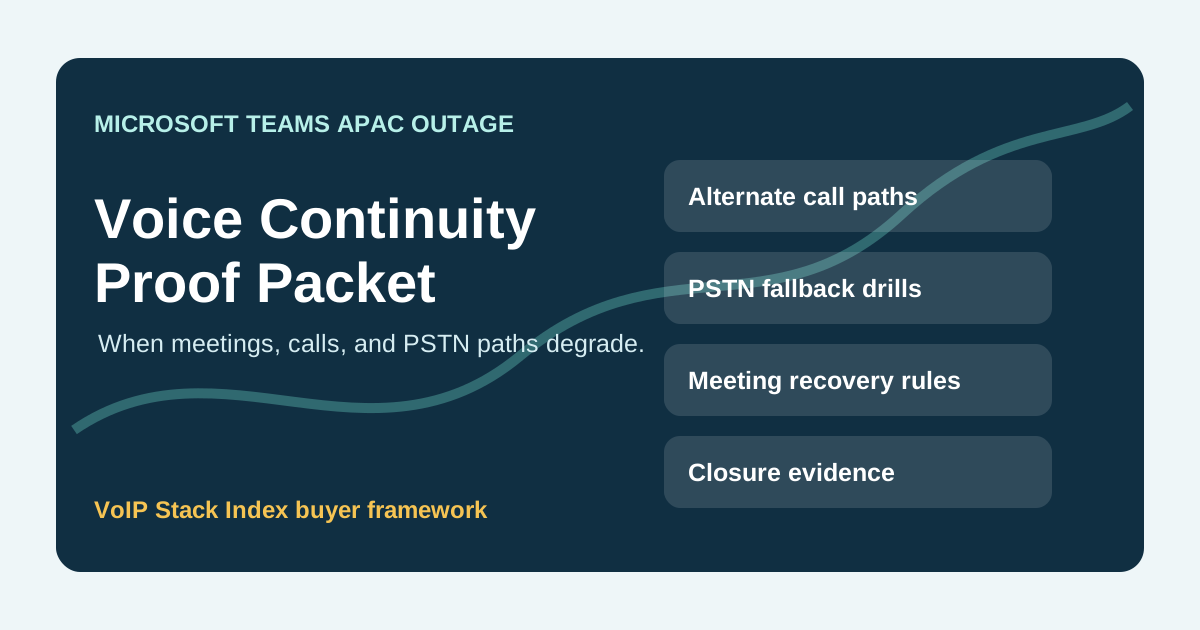
Teams Voice Continuity Proof Packet
A VoIP buyer framework for validating Microsoft Teams and UCaaS continuity across alternate call paths, PSTN fallback, meeting recovery, hotline ownership, customer notices, and incident closure evidence.
What buyers should do next
List every Teams, UCaaS, SIP, PSTN, contact-center, and AI voice path used for customer, sales, support, and incident communications.
Mark which numbers and queues share Microsoft 365 identity, Teams Phone, direct routing, SIP carriers, network paths, or cloud regions.
Run a live fallback drill for the top customer-support number, executive hotline, incident bridge, and outbound-calling path.
Write meeting-recovery rules for critical customer, sales, support, and incident calls before the next regional outage.
Prepare customer-notice and agent-script templates for collaboration or phone degradation.
Use the AI-ready VoIP audit to turn continuity promises into evidence before renewal or provider selection.
Buyer bridge
Do the routing audit before buying the buzz.
The winning AI phone stack is the one that preserves context, controls fallback, and lets humans take over without making the customer repeat the story.
Run the AI-ready VoIP audit