
Direct answer
KDDI 12.23 million email addresses 7.61 million passwords breach July 2026 VoIP provider recovery: what buyers need to know
KDDI confirmed that 12,233,087 email addresses and 7,616,173 passwords tied to its ISP-facing email system were leaked after unauthorized access. The company said the attack involved a vulnerability in third-party software and that it is coordinating password changes with ISP partners. VoIP buyers should use the incident as a provider recovery proof test: shared platforms, credentials, notification, forensics, and fallback routing need evidence before a provider breach reaches customers.
This brief cites the source announcement and translates the event into a buyer framework. Verify current vendor terms before changing phone, messaging, or AI routing.
What happened
- KDDI's July 2026 update said 12,233,087 email addresses and 7,616,173 passwords were confirmed leaked from an ISP-facing mail system.
- The company's PDF said the issue related to a vulnerability in third-party software and described countermeasures including system repair, EDR rollout, forensic review, and password-change coordination.
- The Record independently reported that the affected platform served multiple ISP email services and that KDDI said its own separate consumer mobile and fixed-line email services were not affected.
- Nippon/Jiji Press and The Japan Times reported the confirmed email-address and password counts and KDDI's response.
- The lesson for voice buyers is not that email equals VoIP. It is that communications providers often run shared platforms where one vulnerable component can create broad customer recovery work.
Why this is trending
- The confirmed counts are large enough to make the story a telecom trust issue rather than a routine breach notice.
- The incident involved provider-operated infrastructure serving multiple ISP brands, which maps directly to buyer concerns about shared SIP, UCaaS, voicemail, SMS, portal, and contact-center back ends.
- Credential exposure creates follow-on risk for support desks, phone-admin portals, voicemail, call-detail portals, MFA recovery, number-porting workflows, and customer notification queues.
The VoIP Stack Index take
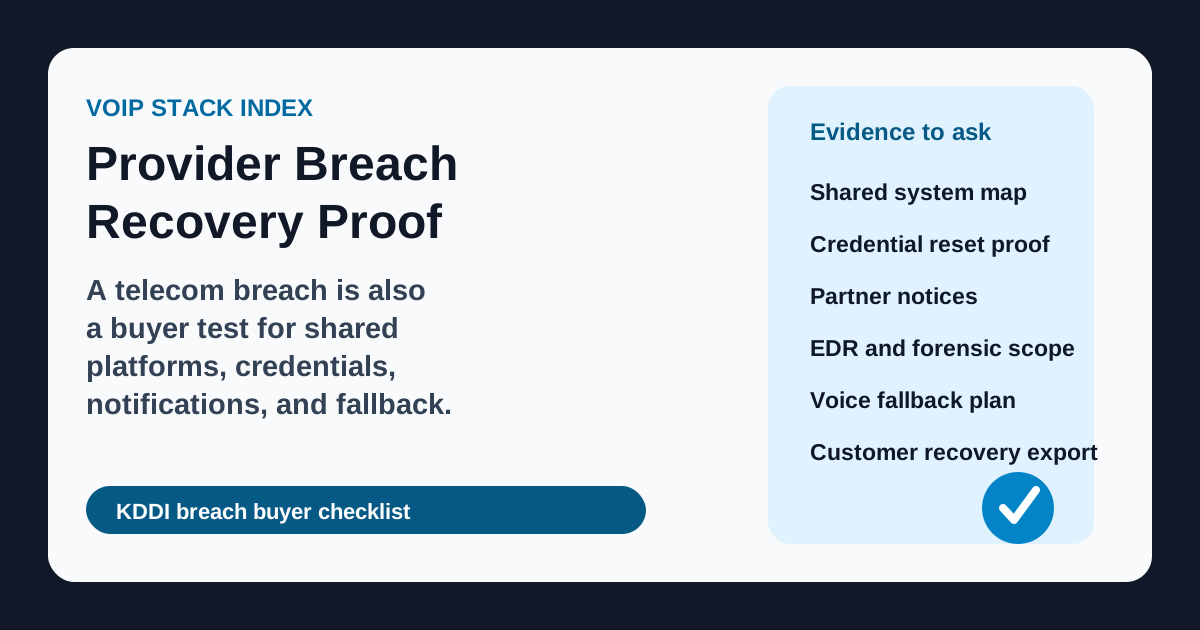
A VoIP buyer should not evaluate a communications provider only by uptime, feature list, or call quality. The buyer needs recovery proof: which shared systems touch the account, which credentials exist, how resets are enforced, which logs prove scope, how customers are notified, how inbound voice fails over, and how the provider exports recovery evidence after an incident.
VoIP Provider Recovery Proof Packet
A buyer framework for validating communications providers across shared-platform exposure, credential reset, forensic scope, partner notification, voice fallback, and recovery evidence.
What buyers should do next
Ask every voice provider which shared systems store admin, voicemail, SIP, SMS, billing, and support credentials.
Separate provider credentials by risk: super-admin, phone-system admin, voicemail, support portal, billing, API, and end-user accounts.
Require MFA, forced-reset capability, password-rotation proof, and completion exports for high-risk communications accounts.
Document alternate routing for revenue, safety, after-hours, support, and dispatch numbers before a provider incident.
After any provider breach, collect a recovery packet with scope, reset status, customer notices, call-impact evidence, and unresolved follow-up items.
Buyer bridge
Do the routing audit before buying the buzz.
The winning AI phone stack is the one that preserves context, controls fallback, and lets humans take over without making the customer repeat the story.
Run the AI-ready VoIP audit