Direct answer
FCC RMD vote VoIP filing proof packet: what buyers need to know
The FCC voted 3-0 on July 22, 2026 to issue a proposal to strengthen the Robocall Mitigation Database, according to ABA Banking Journal. The proposal would clarify which entities must file, require more specific information on illegal-call prevention, limit exemptions, and seek comment on stopping removed bad actors and their principals from reentering the database. VoIP buyers should treat the vote as a filing-proof gate: identify who files, which call-path role the buyer occupies, what the mitigation plan actually says, how third-party routes are controlled, and what evidence exists for traceback, customer vetting, and suspension risk.
This brief cites the source announcement and translates the event into a buyer framework. Verify current vendor terms before changing phone, messaging, or AI routing.
What happened
- The FCC announced on July 22, 2026 that it would further protect U.S. phone networks against robocaller access by strengthening the Robocall Mitigation Database.
- ABA Banking Journal reported the Commission voted 3-0 to issue the proposal.
- ABA said all voice service providers must register in the RMD and submit information on practices used to prevent illegal calls over their networks.
- The reported proposal would clarify which entities must file, require more specific illegal-call prevention information, and limit exemptions from filing requirements.
- ABA also reported that the FCC is seeking comment on measures to stop removed bad actor providers and the people or entities behind them from reentering the RMD.
- CommLaw Group's earlier analysis warned that information-service providers, communications platforms, call centers, SaaS providers, AI platforms, and other PSTN-accessible voice businesses may be pulled closer to the RMD accountability perimeter.
Why this is trending
- The July 22 vote turned a draft proposal into an active comment-period compliance issue for voice providers and adjacent platforms.
- The RMD affects access to the U.S. voice network, so filing accuracy and mitigation proof can become a market-access issue rather than paperwork.
- AI voice agents, SaaS dialers, lead platforms, resellers, and contact-center vendors often rely on upstream numbering and carrier partners, making filing ownership easy to misunderstand.
- The reentry-risk question raises diligence pressure on principals, affiliates, customer-vetting records, and traffic-history evidence.
The VoIP Stack Index take
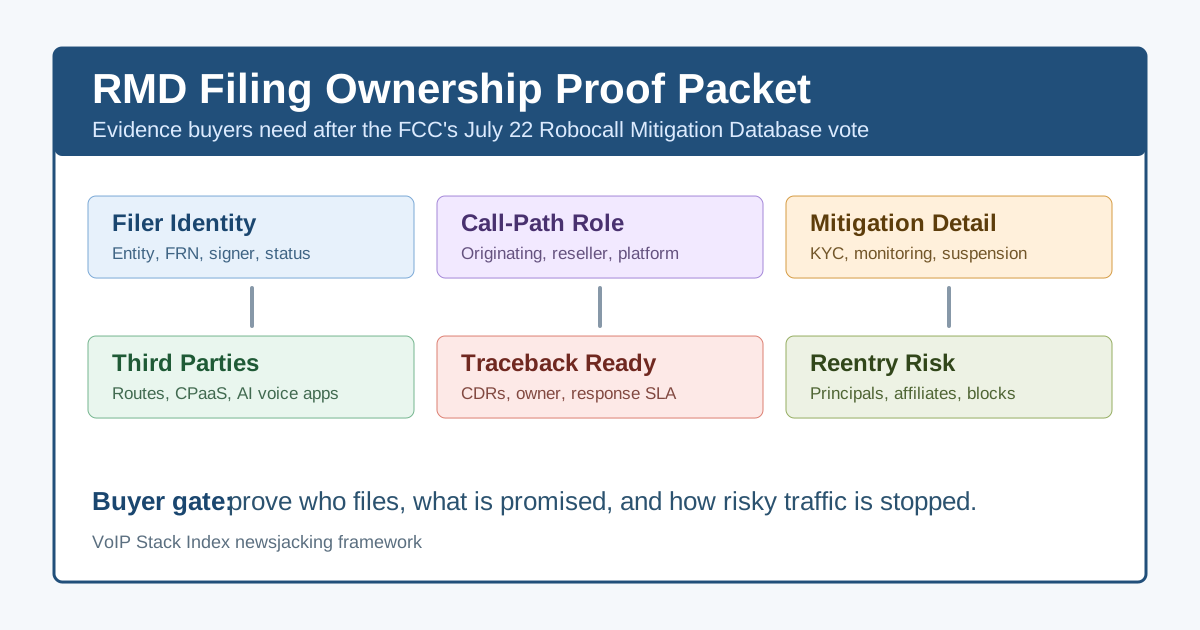
A VoIP buyer should not stop at 'our carrier files in the RMD.' The buyer needs an RMD Filing Ownership Proof Packet: filer identity, call-path role, upstream and downstream responsibilities, mitigation plan text, KYC records, traceback process, customer traffic controls, suspension or removal monitoring, and evidence that removed bad actors cannot reappear through a related entity or route.
RMD Filing Ownership Proof Packet
A VoIP buyer framework for validating Robocall Mitigation Database accountability across filer identity, call-path role, mitigation plan detail, third-party dependencies, traceback readiness, reentry risk, and customer traffic proof.
What buyers should do next
Pull the current RMD filing for every entity, provider, reseller, and platform account in the voice stack.
Map where business phone, SIP, CPaaS, contact-center, dialer, and AI voice-agent traffic enters the U.S. voice network.
Compare the filed mitigation plan against actual KYC, traffic monitoring, traceback, and suspension workflows.
Confirm whether any upstream provider filing is being treated as coverage for buyer-controlled traffic.
Create a reentry-risk screen for customers, principals, affiliates, domains, payment details, and related-number usage.
Use the AI-ready VoIP audit to turn RMD filing claims into evidence before customers or regulators ask for it.
Buyer bridge
Do the routing audit before buying the buzz.
The winning AI phone stack is the one that preserves context, controls fallback, and lets humans take over without making the customer repeat the story.
Run the AI-ready VoIP audit