Direct answer
FCC NG911 July 2026 IP 911 reliability interoperability VoIP routing proof: what buyers need to know
The Federal Register published the FCC's NG911 reliability and interoperability action on July 10, 2026, summarizing FCC 26-39 in PS Docket Nos. 21-479 and 13-75. The FCC says the proceeding modernizes Next Generation 911 reliability and interoperability, and the public notice says adopted rules take effect August 10, 2026 while some compliance dates depend on OMB review. VoIP buyers should treat the update as a prompt to request emergency-call routing proof from carriers, SIP trunk providers, UCaaS platforms, CPaaS vendors, and managed SBC operators.
This brief cites the source announcement and translates the event into a buyer framework. Verify current vendor terms before changing phone, messaging, or AI routing.
What happened
- The Federal Register published the FCC's NG911 reliability and interoperability proceeding on July 10, 2026, covering PS Docket Nos. 21-479 and 13-75 and FCC 26-39.
- The FCC's document says it modernizes Next Generation 911 reliability and interoperability while seeking further comment on related reliability and testing issues.
- An FCC public notice released July 10 says the adopted rules take effect August 10, 2026, with information-collection compliance dates to follow OMB review.
- The FCC record discusses IP-based 911 traffic, major IP transport and aggregation facilities, outage prevention, and interoperability testing around the NG911 transition.
- For buyers, the issue is not only public-safety compliance. It is whether every IP voice path can prove emergency routing, location, carrier handoff, failover, and incident evidence.
Why this is trending
- The rulemaking lands while business voice is moving deeper into IP networks, cloud calling, CPaaS, managed SBCs, AI calling, and distributed work.
- Emergency calls are low-volume but high-consequence. A provider can look healthy on ordinary calling while still having weak 911 location, routing, failover, or outage evidence.
- The FCC's NG911 focus turns emergency voice readiness into a buyer diligence item, not only a carrier-regulatory issue.
The VoIP Stack Index take
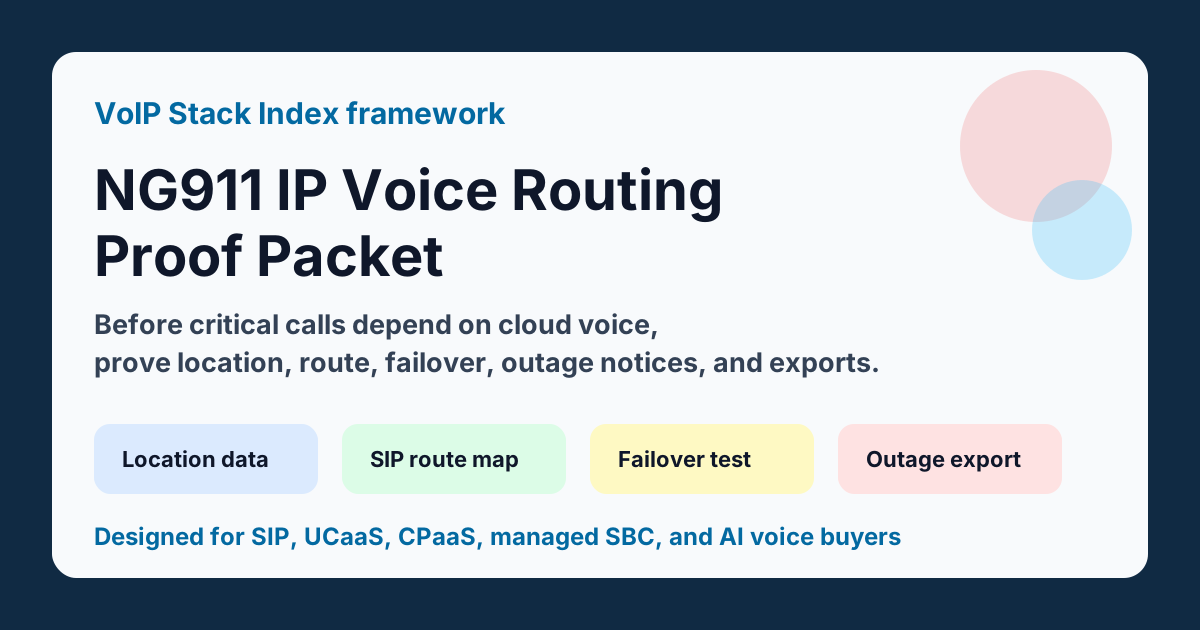
A VoIP buyer should not accept a generic '911 supported' claim. The buyer needs an NG911 IP Voice Routing Proof Packet: registered location workflow, SIP route map, provider handoff, emergency-number test evidence, outage-notice path, failover plan, support escalation, and exportable logs after any failed or misrouted emergency call.
NG911 IP Voice Routing Proof Packet
A buyer framework for validating VoIP and managed voice providers across 911 location, SIP routing, carrier handoff, failover, outage notice, testing, and evidence export.
What buyers should do next
Ask every VoIP, UCaaS, SIP trunk, CPaaS, managed SBC, and AI voice provider for its emergency-call routing evidence.
Map registered locations to users, devices, numbers, branches, remote workers, and shared lines before production changes.
Request the actual 911 traffic path, including SBCs, carriers, resellers, aggregation providers, failover routes, and support contacts.
Document approved emergency-call testing and outage-notification procedures instead of relying on generic status pages.
Preserve post-incident evidence requirements before a failed or misrouted emergency call becomes a live dispute.
Buyer bridge
Do the routing audit before buying the buzz.
The winning AI phone stack is the one that preserves context, controls fallback, and lets humans take over without making the customer repeat the story.
Run the AI-ready VoIP audit