Direct answer
FCC direct to device satellite unlicensed devices backup voice proof July 2026: what buyers need to know
The FCC announced in July 2026 that Chairman Brendan Carr proposed expanding direct-to-device satellite connectivity for unlicensed devices, with the item scheduled for consideration at the July 22 open meeting. NTIA's related D2D filing recommended FCC attention to GPS L1 protection and limits for devices that cannot meet emissions requirements. VoIP buyers should treat the FCC action as a backup-voice proof trigger: verify whether satellite/device fallback can carry the specific calls, users, queues, emergency scenarios, and outage evidence the business needs.
This brief cites the source announcement and translates the event into a buyer framework. Verify current vendor terms before changing phone, messaging, or AI routing.
What happened
- The FCC posted a July 2026 item titled FCC to Consider Direct-to-Device Connectivity for Unlicensed Devices.
- The notice says Chairman Brendan Carr proposed expanding direct-to-device satellite connectivity, with Commission consideration scheduled for the July 22, 2026 open meeting.
- The FCC had already acted in April 2026 to support direct-to-device satellite connectivity and reduce coverage gaps for consumers, businesses, and IoT use cases.
- NTIA's D2D recommendation letter to the FCC focused on technical guardrails, including protection for GPS L1 and limits for noncompliant user equipment.
- For business voice buyers, the issue is not whether D2D is promising. It is whether a specific provider can prove fallback calling, emergency limits, and incident evidence before an outage.
Why this is trending
- Direct-to-device satellite connectivity is moving from carrier marketing into FCC agenda work, which gives buyers a regulatory milestone instead of a rumor.
- Business calling increasingly depends on mobile workers, remote staff, field teams, UCaaS apps, softphones, AI voice tools, and customer queues that can fail when terrestrial access is weak.
- Satellite fallback can help with coverage gaps, but it may not cover every device, number, queue, emergency call, bandwidth need, region, or regulatory constraint.
The VoIP Stack Index take
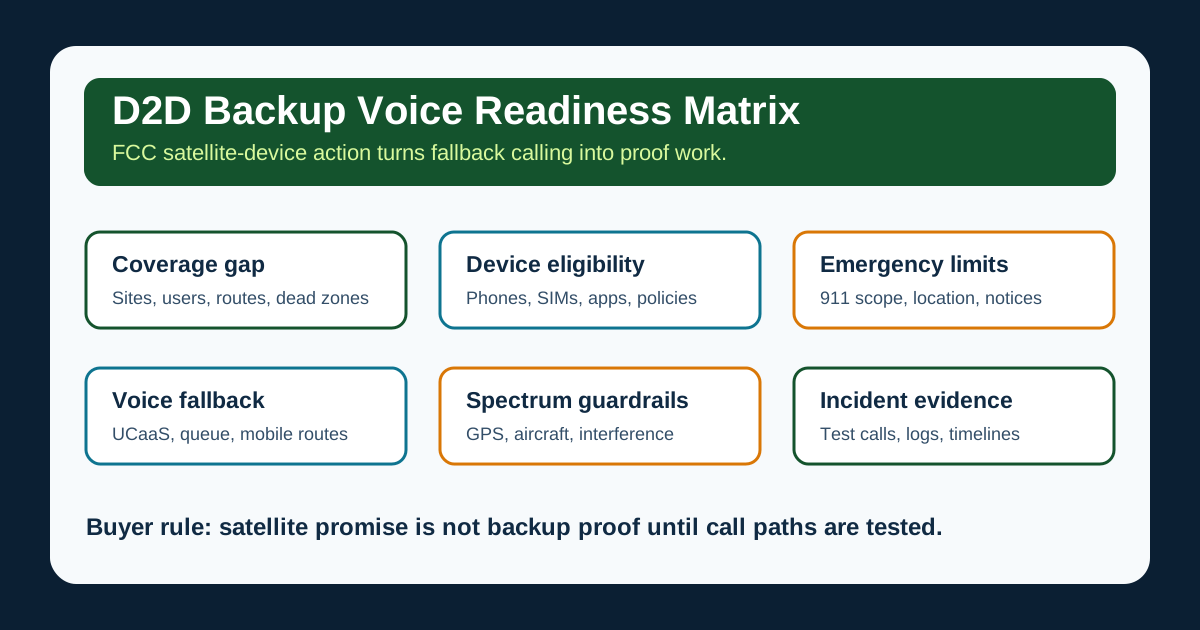
A VoIP buyer should not accept a generic satellite-connectivity claim as continuity proof. The buyer needs a D2D Backup Voice Readiness Matrix: coverage-gap inventory, eligible devices and SIMs, emergency-call limits, UCaaS fallback path, GPS and spectrum guardrails, alert owner, test-call evidence, and post-incident exports.
D2D Backup Voice Readiness Matrix
A buyer framework for validating direct-to-device satellite backup voice readiness across coverage gaps, device eligibility, emergency limits, UCaaS fallback, spectrum guardrails, and incident evidence.
What buyers should do next
List every critical voice workflow that depends on mobile or weak terrestrial coverage, including field service, after-hours calls, AI voice agents, and contact-center queues.
Ask providers which devices, SIMs, carriers, plans, regions, and apps are actually eligible for D2D fallback.
Document emergency-call limitations, location behavior, aircraft restrictions, and user notices before labeling the path resilient.
Run test calls for inbound queue routing, outbound calls, voicemail, SMS callback, softphone behavior, and live-agent fallback.
Require a post-incident evidence packet with CDRs, device logs, carrier status, affected users, and recovery timestamps.
Buyer bridge
Do the routing audit before buying the buzz.
The winning AI phone stack is the one that preserves context, controls fallback, and lets humans take over without making the customer repeat the story.
Run the AI-ready VoIP audit