
Direct answer
FCC November 2026 direct access telephone numbers national security VoIP draft: what buyers need to know
The FCC circulated a draft Fourth Report and Order and Fourth Further Notice of Proposed Rulemaking on October 29 for its November 19 open meeting. It concerns interconnected VoIP providers that obtain numbers directly from numbering administrators and would add national-security certifications and disclosures for direct-number access. The item is not final. Buyers should not treat it as a new requirement today; they should use it to ask whether a provider can document the entity, number-access authority, ownership, equipment posture, authorization history and change controls behind production numbers.
This brief cites the source announcement and translates the event into a buyer framework. Verify current vendor terms before changing phone, messaging, or AI routing.
What happened
- The circulated FCC item concerns direct access to North American Numbering Plan resources by interconnected VoIP providers, rather than every company that simply buys a hosted phone seat.
- The draft would require new and existing direct-access authorization holders to make specified certifications about Covered List status, covered equipment or services, and certain Section 214 history, subject to the final text and effective dates.
- The accompanying further notice asks about additional proposals, including security and transparency measures; those questions are not final obligations.
- The FCC is scheduled to consider the circulated item at its November 19, 2026 open meeting.
Why this is trending
- Number access is an upstream control point: a business may know its VoIP brand without knowing which entity holds the number authorization or how a material provider change is handled.
- The draft connects phone-number sourcing with ownership, equipment and national-security attestations, expanding the buyer conversation beyond price and per-minute rates.
- This is distinct from the site's recent robocall and route-failure coverage: the proof packet focuses on direct-number authority and supplier-governance evidence.
The VoIP Stack Index take
This is not a reason for every buyer to demand an FCC filing from every hosted-phone vendor. It is a reason to match the diligence to the route. For a provider that directly obtains numbers, resells direct-access numbers or carries critical SIP, AI-voice, verification or contact-center traffic, request a clear explanation of the legal entity, upstream authorization, number source, ownership-change notice, equipment responsibility and escalation path. This is editorial procurement guidance, not legal advice or a compliance finding about any provider.
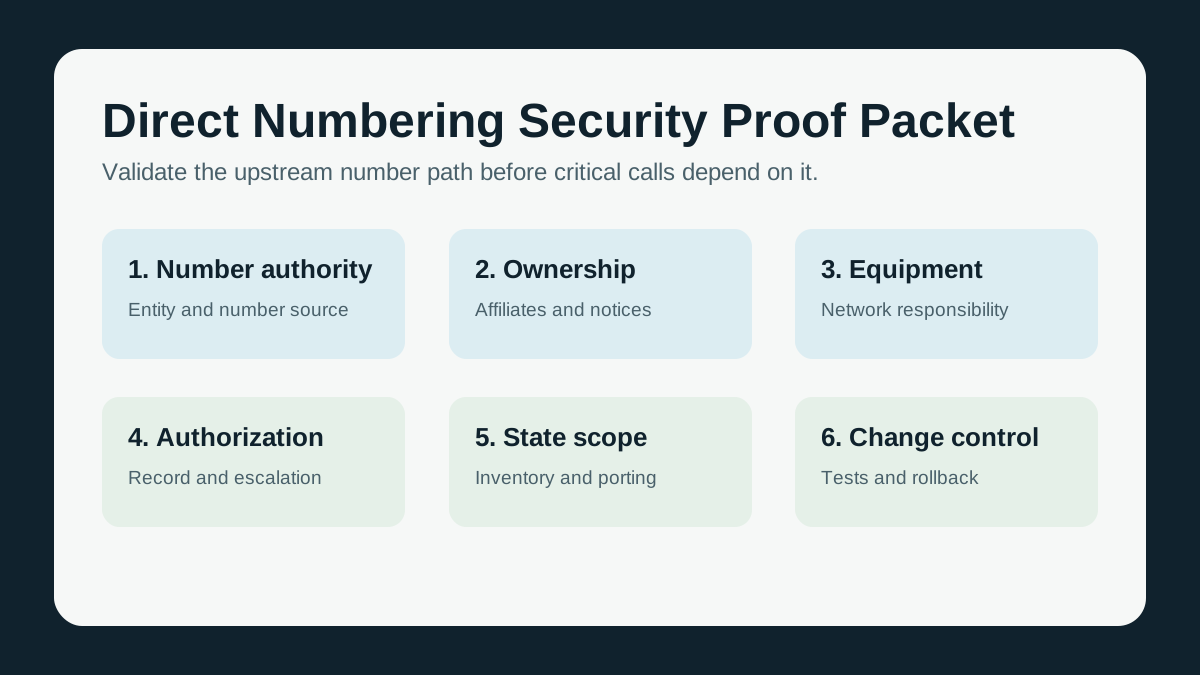
Direct Numbering Security Proof Packet
A buyer framework for validating direct-number authority, ownership, equipment, authorization history, state scope and change control before routing critical voice traffic.
What buyers should do next
Classify whether each critical number is hosted, reseller-supplied or obtained through a direct-access provider.
Ask the provider to identify the legal entity and upstream authority behind the number path.
Record ownership, equipment, state-scope and change-control evidence with the telecom supplier file.
Follow the November 19 FCC meeting outcome before treating the circulated draft as a final rule.
Buyer bridge
Do the routing audit before buying the buzz.
The winning AI phone stack is the one that preserves context, controls fallback, and lets humans take over without making the customer repeat the story.
Run the AI-ready VoIP audit