
Direct answer
FAA ground stop telecommunications outage business voice fallback: what buyers need to know
On November 13, the FAA issued a nationwide ground stop after communications trouble affected air-traffic control centers. The incident is not evidence that a particular business phone provider failed, and it should not be used to infer its cause before investigators report one. For business voice buyers, the useful lesson is narrower: a primary call path is not a continuity plan. Teams need a named incident owner, alternate customer channels, tested forwarding or callback routes, a record of work that arrived during the disruption, and a recovery test before declaring normal service restored.
This brief cites the source announcement and translates the event into a buyer framework. Verify current vendor terms before changing phone, messaging, or AI routing.
What happened
- The FAA ordered a nationwide ground stop on November 13 amid communications problems; AP reported that the issue affected air-traffic control centers and that officials said there was no indication at that point of a malicious act.
- The event was high consequence because voice and data communications are operational dependencies, not simply a convenience layer. The precise technical cause and any remediation findings should remain subject to official investigation.
- The buyer lesson is not to copy aviation controls into an ordinary office. It is to distinguish an incident notification from a working alternate route, and a restored dashboard from reconciled customer work.
Why this is trending
- A nationwide aviation ground stop is a visible example of how communications failures can become operational failures across many dependent organizations.
- The incident followed other highly visible service disruptions this week, increasing buyer attention on single-provider and single-channel dependencies.
- It creates a concrete test: can a customer, supplier or on-call employee still reach the organization, receive a trustworthy update, and have their request reconciled afterward?
The VoIP Stack Index take
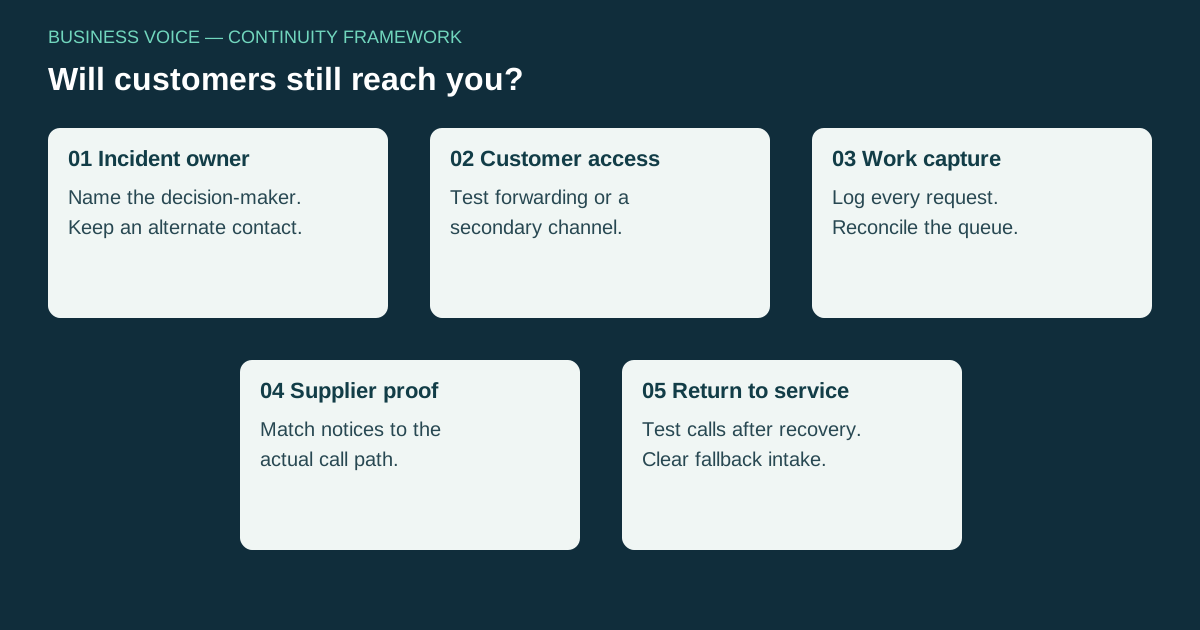
Treat this map as an illustrative procurement and operations exercise, not a finding about the FAA or any named provider. Use fictional test calls or other authorized data. The aim is to prove the exact contracted call paths your organization uses: which number forwards, which backup line or message channel receives the request, who owns the public update, how records are reconciled, and when the normal path is safe to resume. A provider statement, an application status page and a successful inbound test are three different kinds of evidence.
Business Voice Escalation-and-Fallback Map
An illustrative five-part test for proving how an organization will notify, reroute, recover and account for customer conversations when its normal communications path is unavailable.
What buyers should do next
List every customer-facing number, carrier route, after-hours rule and named owner used in normal operations.
Run an authorized fallback drill that tests forwarding, a secondary channel, recorded notice and callback capture.
Reconcile fictional test contacts to the CRM or ticket queue and document duplicate-prevention behavior.
Ask providers how incident scope, customer notices and recovery evidence map to the exact service you contract.
Keep the fallback path until normal service and the reconciliation list pass acceptance.
Buyer bridge
Do the routing audit before buying the buzz.
The winning AI phone stack is the one that preserves context, controls fallback, and lets humans take over without making the customer repeat the story.
Run the AI-ready VoIP audit