
Direct answer
Cisco Unified CM CVE-2026-20230 exploited in attacks: what buyers need to know
Cisco Unified Communications Manager CVE-2026-20230 is a server-side request forgery vulnerability that Cisco says can allow an unauthenticated remote attacker to send crafted requests and make the affected system initiate arbitrary network requests. CISA added the flaw to its Known Exploited Vulnerabilities catalog after reports of active exploitation. VoIP buyers should treat the news as a phone-system security proof test, not only a patch notice.
This brief cites the source announcement and translates the event into a buyer framework. Verify current vendor terms before changing phone, messaging, or AI routing.
What happened
- Cisco's advisory describes CVE-2026-20230 as a server-side request forgery issue affecting Cisco Unified Communications Manager and Unified CM Session Management Edition.
- Cisco says the flaw exists because of insufficient validation of user-supplied input and can be triggered by crafted requests to an affected system.
- NVD lists CVE-2026-20230 as a high-severity vulnerability and points buyers back to Cisco's official advisory for affected products and remediation.
- CISA added CVE-2026-20230 to the Known Exploited Vulnerabilities catalog, which means federal civilian agencies have a required remediation timeline and private buyers should treat it as active risk.
- BleepingComputer reported that the Unified CM and SME flaw is now being exploited in attacks, moving the story from theoretical patching to incident-readiness.
Why this is trending
- Unified Communications Manager sits in the middle of enterprise voice, SIP routing, emergency calling, voicemail, conferencing, and call-center workflows.
- A voice-platform vulnerability can turn into business disruption even when the data breach story is still unclear, because phones, queues, recordings, and escalations carry daily operations.
- The CISA exploited-vulnerability listing gives telecom, security, and operations teams a concrete reason to prioritize voice infrastructure instead of treating it as legacy back-office equipment.
The VoIP Stack Index take
A VoIP buyer should not judge a provider or managed service by whether it says a patch exists. The buyer needs proof: affected-system inventory, admin isolation, patch status, exposed interface review, SIP trunk fallback, E911 behavior, call-recording continuity, monitoring, incident ownership, and a rollback procedure.
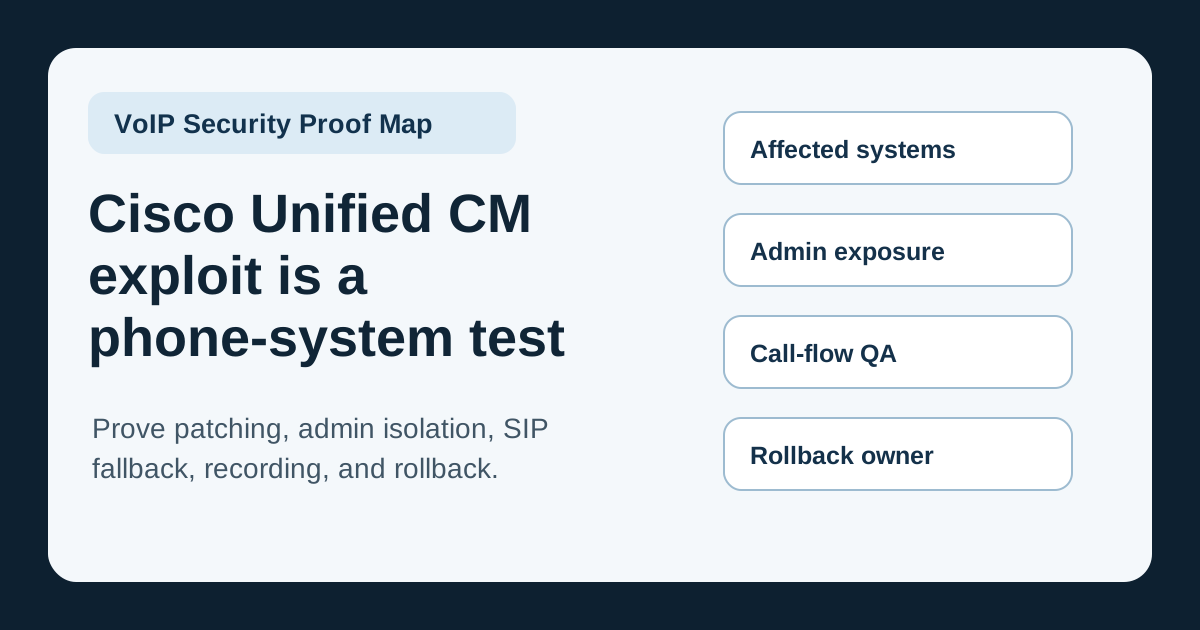
VoIP Security Proof Map
A buyer framework for validating voice-platform patching, admin exposure, SIP trunk continuity, emergency calling, recording retention, monitoring, incident ownership, and rollback before a phone-system vulnerability becomes an outage.
What buyers should do next
Inventory Cisco Unified CM, SME, voicemail, SIP trunk, emergency calling, recording, and call-center dependencies.
Check whether any management or service interfaces are reachable beyond the intended network boundary.
Apply Cisco's recommended remediation through a tested maintenance window with call-flow validation.
Run test calls for inbound, outbound, transfer, emergency, recording, IVR, queue, and failover paths after patching.
Ask every VoIP provider or managed service for patch evidence, affected-system scope, monitoring, and rollback ownership.
Buyer bridge
Do the routing audit before buying the buzz.
The winning AI phone stack is the one that preserves context, controls fallback, and lets humans take over without making the customer repeat the story.
Run the AI-ready VoIP audit