
Direct answer
Cisco IOS XR critical patch voice route proof packet: what buyers need to know
Cisco's September 2026 IOS XR critical advisory is a voice-continuity proof event. Cisco says all IOS XR releases, including IOS XR7, are affected regardless of configuration; the maximum CVSS score is 9.8; fixed software and SMUs are available for many trains; and there are no workarounds. VoIP buyers should ask providers to prove which carrier-grade routers touch the voice path, which fixed release or SMU closes exposure, how calls route during maintenance, and who owns rollback if quality, routing or emergency-calling behavior changes.
This brief cites the source announcement and translates the event into a buyer framework. Verify current vendor terms before changing phone, messaging, or AI routing.
What happened
- Cisco's advisory was first published September 2, 2026 and updated September 11, 2026 as version 2.0 final.
- Cisco rates the IOS XR Software Security Hardening Release critical and lists a maximum CVSS base score of 9.8.
- Cisco says all releases of Cisco IOS XR Software, including IOS XR7 software, are affected regardless of device configuration.
- The advisory groups multiple internally discovered vulnerabilities by CWE and lists issue classes including resource-lifetime control, access control, neutralization, control flow, protection mechanism and exception-handling weaknesses.
- Cisco says no workaround addresses the vulnerabilities and recommends upgrading to fixed software or applying the appropriate SMUs where available.
- HKCERT separately summarized the impacts as denial of service, security restriction bypass, data manipulation, remote code execution and information disclosure for Cisco IOS XR.
Why this is trending
- Carrier-grade router maintenance is no longer invisible to business-phone buyers when voice, emergency access, SIP trunks, UCaaS routes and branch failover depend on IP routing layers.
- The advisory is critical, broad across IOS XR releases and fresh enough to trigger maintenance-window planning rather than a someday patch backlog.
- Cisco says the flaws are not known to be exploited, but the absence of workarounds makes the fixed-release or SMU path the evidence buyers need to request.
- VoIP outages often get investigated at the phone-system layer even when the root cause lives in routing, MPLS, IGP, BGP, transport, firewall or carrier maintenance.
- Buyers need change evidence because a successful patch still has to preserve call quality, route convergence, E911 assumptions, monitoring and rollback timing.
The VoIP Stack Index take
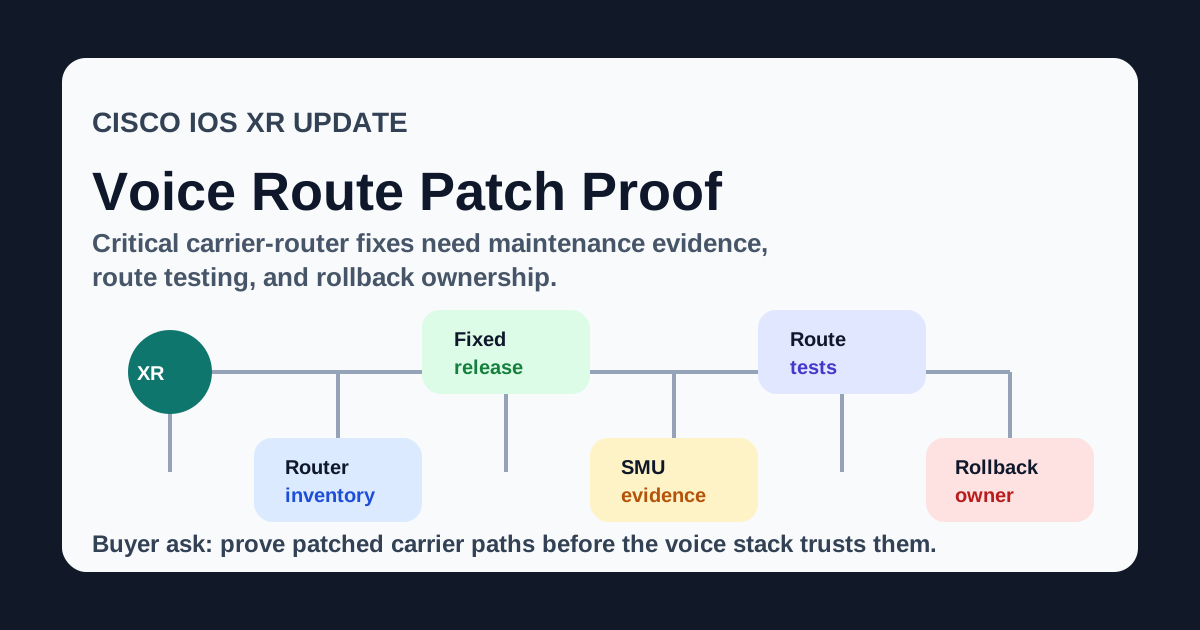
A VoIP buyer should not ask only whether the provider patched Cisco. Ask for a Voice Route Patch Proof Packet: affected-router inventory, software train, fixed release or SMU, voice-route dependency, maintenance window, test-call evidence, route-convergence checks, emergency-call assumptions, monitoring alerts, rollback owner and customer communication. The point is not to second-guess the network team; it is to prove the voice path survived the security fix.
Voice Route Patch Proof Packet
A VoIP buyer framework for validating carrier-router security maintenance across router inventory, fixed releases, SMUs, route tests, rollback, monitoring and customer communication.
What buyers should do next
Ask providers whether Cisco IOS XR devices participate in the managed voice, SIP, E911, branch, MPLS, SD-WAN or carrier handoff path.
Request the affected-router inventory, software train and fixed-release or SMU evidence for the relevant environment.
Schedule post-maintenance voice route checks covering normal calls, representative branches, SIP trunks, failover and emergency-call assumptions.
Require a rollback owner, trigger thresholds and customer communication plan before the maintenance window opens.
Keep the proof packet with the VoIP continuity plan so future outages do not start from a blank network map.
Buyer bridge
Do the routing audit before buying the buzz.
The winning AI phone stack is the one that preserves context, controls fallback, and lets humans take over without making the customer repeat the story.
Run the AI-ready VoIP audit