Direct answer
CISA Iranian PLC warning voice continuity proof map: what buyers need to know
CISA's July 22, 2026 revised joint advisory warns that Iranian-affiliated actors are exploiting internet-connected PLCs across U.S. critical infrastructure, including government services, water and wastewater, and energy. The advisory says some victims experienced operational disruption and financial loss after PLC, HMI, and SCADA manipulation. VoIP buyers should treat the warning as a voice-continuity proof test: critical phones, incident hotlines, dispatch paths, customer notifications, carrier failover, and post-incident closure evidence must work when OT systems are unstable.
This brief cites the source announcement and translates the event into a buyer framework. Verify current vendor terms before changing phone, messaging, or AI routing.
What happened
- CISA last revised the joint advisory on July 22, 2026.
- The advisory was issued with FBI, NSA, EPA, DOE, U.S. Cyber Command's Cyber National Mission Force, and Treasury.
- CISA says the authoring agencies are urgently warning U.S. organizations about ongoing Iranian-affiliated cyber exploitation of internet-connected OT devices, including PLCs.
- The advisory identifies affected sectors including Government Services and Facilities, Water and Wastewater Systems, and Energy.
- CISA says organizations experienced disruptions through malicious project-file interactions and manipulation of HMI and SCADA display data, and that some cases caused operational disruption and financial loss.
- TechCrunch independently covered the warning on July 23, 2026 as a current U.S. government alert about water and energy providers.
Why this is trending
- The July 22 revision adds current urgency to a critical-infrastructure warning that already affects municipalities, utilities, and energy operators.
- Operational technology incidents can become customer, field, and emergency-communications incidents if voice paths depend on the same sites, networks, people, or recovery processes.
- The story lands during broader scrutiny of critical-infrastructure resilience, where buyers need tested evidence rather than general uptime promises.
- VoIP, SIP, UCaaS, contact-center, and AI voice-agent providers are increasingly part of incident notification and dispatch workflows, so continuity proof is now a procurement issue.
The VoIP Stack Index take
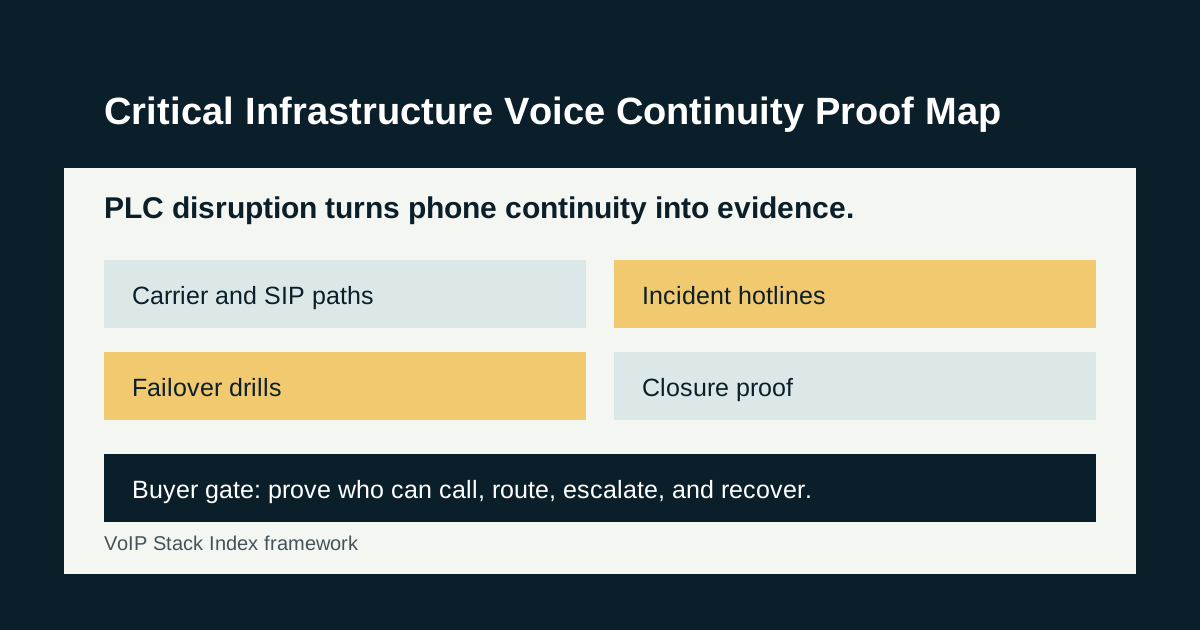
A utility, municipality, or critical-infrastructure supplier should not ask only whether the phone provider has high uptime. The buyer needs a Critical Infrastructure Voice Continuity Proof Map: independent carrier paths, emergency and executive hotlines, dispatch-phone fallback, SIP and PSTN failover, field-contact inventory, customer-notice triggers, tabletop drill records, and closure evidence after the OT incident.
Critical Infrastructure Voice Continuity Proof Map
A VoIP buyer framework for validating utility and municipal voice continuity across carrier paths, emergency hotlines, dispatch phones, field escalation, failover drills, customer notices, and incident closure proof.
What buyers should do next
List every phone number, SIP trunk, UCaaS queue, contact-center route, AI voice workflow, hotline, and field-phone path used during infrastructure incidents.
Mark which voice paths share sites, internet links, identity providers, cloud regions, power sources, or OT recovery staff.
Run a live failover drill for the highest-risk public, regulator, dispatch, and executive phone paths.
Create customer-notice and field-dispatch scripts that work when normal dashboards or apps are unavailable.
Require closure evidence that voice continuity stayed usable throughout the OT incident, not only after systems recovered.
Use the AI-ready VoIP audit to turn continuity claims into evidence before the next critical-infrastructure warning becomes a live incident.
Buyer bridge
Do the routing audit before buying the buzz.
The winning AI phone stack is the one that preserves context, controls fallback, and lets humans take over without making the customer repeat the story.
Run the AI-ready VoIP audit