
Direct answer
Bell NG9-1-1 software outage 87 minutes CRTC report October 2026: what buyers need to know
CBC reported via Yahoo on October 2 that Bell told the CRTC a latent software issue caused an 87-minute September 17 outage affecting parts of its next-generation 9-1-1 system. Bell said the incident was not a cyberattack or planned change. MobileSyrup reported on October 6 that two early alarms did not trigger the expected war-room response and that engineers were alerted after another system detected an unusual drop in 9-1-1 traffic. Public accounts differ on whether five or six provinces were affected, so buyers should keep the official filing and secondary coverage separate. For VoIP buyers, the practical task is to ask providers how emergency routes are monitored, how backup relay works, who reconciles missed calls and what retest evidence exists after a software failure.
This brief cites the source announcement and translates the event into a buyer framework. Verify current vendor terms before changing phone, messaging, or AI routing.
What happened
- CBC's report says Bell attributed the outage to a previously undetected software issue affecting NG9-1-1 components and said it restored service after 87 minutes.
- The same report says Bell told the CRTC the incident was not a cyberattack and did not result from planned or unplanned change activity.
- MobileSyrup reported that early alarms occurred but did not trigger Bell's war-room response, while a later alarm on traffic drop alerted engineers.
- Bell's report and secondary coverage differ on the province count. That uncertainty is a reminder to retain source-specific outage evidence instead of relying on a single headline.
Why this is trending
- Emergency calling is migrating to IP-based NG9-1-1 infrastructure, where software components, monitoring and relay processes can become buyer-relevant reliability evidence.
- An outage that affects new emergency calls is not an ordinary status-page incident. It forces buyers to ask how their voice providers test critical route monitoring and backup procedures.
- The story is distinct from recent FCC rule and robocall stories: this buyer asset focuses on software failure detection, backup relay and post-incident acceptance evidence.
The VoIP Stack Index take
Consider an illustrative multi-site business using hosted VoIP, mobile failover and a backup SIP provider. The buyer may not control the national emergency network, but it can ask its voice vendors what happens when emergency-call routing software fails upstream: which paths are affected, how new calls are relayed, who receives alarms, whether missed-call records are delivered, and how the route is retested before acceptance. This framework is an editorial procurement aid, not a legal finding about Bell, CRTC obligations or any provider's current emergency-call compliance.
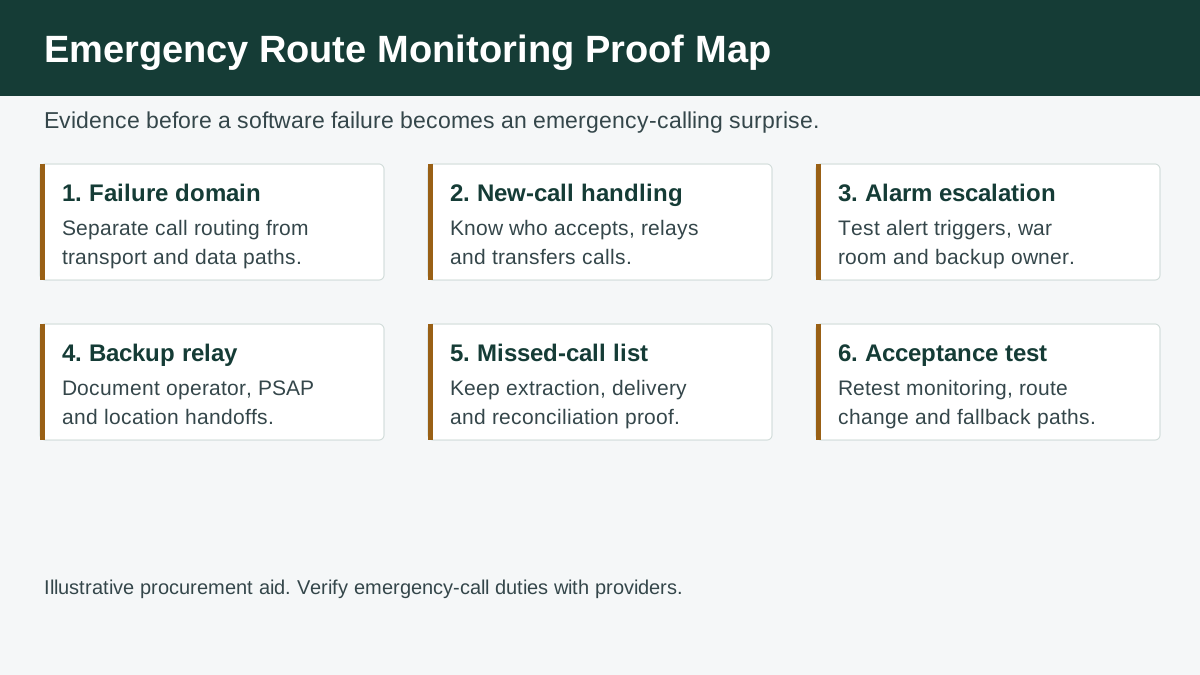
Emergency Route Monitoring Proof Map
An original buyer map for validating emergency-call failure domains, new-call handling, alarm escalation, backup relay, missed-call reconciliation and route acceptance testing.
What buyers should do next
Ask voice, SIP, CPaaS and contact-center providers which emergency-call routing components they monitor directly and which depend on upstream carriers.
Request the incident trigger list for failed alarms, traffic drops, route refusal, transfer failures and PSAP relay exceptions.
Document backup relay behavior for mobile, VoIP, Wi-Fi calling, SIP trunk and analog-adapter emergency paths.
Confirm whether missed emergency-call records can be extracted, delivered to the right parties and reconciled after restoration.
Keep post-incident test evidence with the phone-system acceptance record instead of relying on a generic uptime promise.
Buyer bridge
Do the routing audit before buying the buzz.
The winning AI phone stack is the one that preserves context, controls fallback, and lets humans take over without making the customer repeat the story.
Run the AI-ready VoIP audit