Direct answer
Bandwidth +52 country code caller ID incident routing proof packet: what buyers need to know
Bandwidth's public status page said the +52 country code was being prepended to the calling number in a BWI Platform incident isolated to a specific carrier and a sub-set of traffic. Bandwidth investigated on July 30, monitored expected calling behavior later that day, and marked the incident resolved on July 31, 2026. VoIP buyers should treat the event as caller-ID proof work: require carrier scope, affected number pools, CDR samples, normalization rules, proof calls, customer notices, and recovery evidence.
This brief cites the source announcement and translates the event into a buyer framework. Verify current vendor terms before changing phone, messaging, or AI routing.
What happened
- Bandwidth opened the incident on July 30, 2026, saying the +52 country code was being prepended to the calling number.
- The official incident language narrowed the issue to a specific carrier and a sub-set of traffic on the BWI Platform.
- Bandwidth said teams observed expected calling behaviors later on July 30 and continued monitoring on July 31.
- Bandwidth marked the incident resolved on July 31, 2026 at 19:02 EDT.
- IsDown mirrored the same incident and listed it as a recent Bandwidth outage with a roughly one-day duration.
- StatusGator also listed the +52 incident in recent Bandwidth outage history with warning-severity windows.
Why this is trending
- The incident had an official carrier-platform status page, a public timeline, and independent status mirrors.
- It was narrow enough to slip past generic provider-uptime checks while still affecting how calling numbers appeared downstream.
- Caller-ID formatting affects callbacks, spam and fraud screening, CRM matching, call attribution, regulated outreach, and support recovery queues.
- The same week also included multiple Bandwidth voice and portal incidents, reminding buyers to test route-specific behavior rather than account-level uptime only.
The VoIP Stack Index take
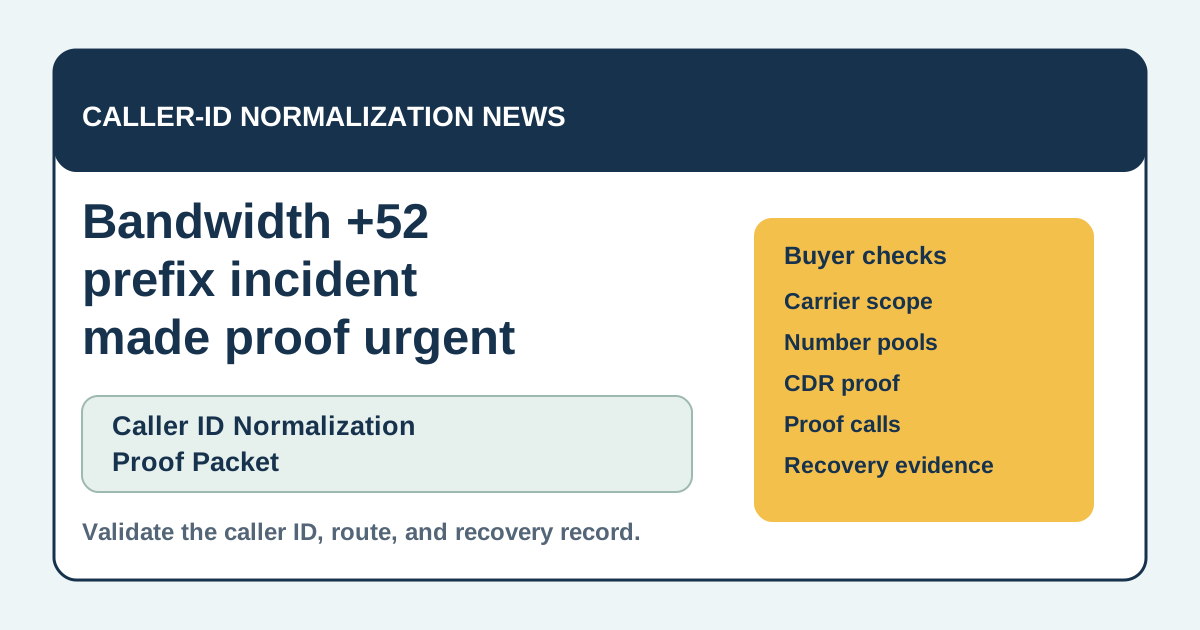
A VoIP buyer should not accept green platform status as caller-ID proof. Ask the provider and telecom owner for a Caller ID Normalization Proof Packet showing which carrier path changed the number, which originating pools were affected, what CDR fields prove the malformed caller ID, whether CRM and spam-screening logic misclassified calls, which proof calls passed after recovery, and what customer or agent notices closed the loop.
Caller ID Normalization Proof Packet
A VoIP and UCaaS buyer framework for validating caller-ID formatting incidents across carrier scope, number pools, CDR samples, route normalization, proof calls, customer notices, and recovery evidence.
What buyers should do next
Export call-detail records around the incident window by originating DID, displayed caller ID, destination, carrier path, queue, and CRM account.
Run proof calls through representative routes and confirm what appears on desk phones, mobile devices, IVR logs, and CRM records.
Check whether malformed caller IDs affected callback success, spam labeling, fraud rules, campaign attribution, or regulated outreach records.
Document which normalization rules are automatic, which require human approval, and which legitimate international IDs must be excluded.
Create a recovery queue for missed calls, failed callbacks, sales attribution gaps, and customer-support cases created during the incident window.
Use the VoIP Stack Index AI-ready VoIP audit and VoIP cost calculator to convert caller-ID and route proof into buying requirements.
Buyer bridge
Do the routing audit before buying the buzz.
The winning AI phone stack is the one that preserves context, controls fallback, and lets humans take over without making the customer repeat the story.
Run the AI-ready VoIP audit