
Direct answer
AT&T Amazon Leo satellite VoIP failover proof packet: what buyers need to know
AT&T Business announced on September 8, 2026 that it will offer Amazon Leo low Earth orbit satellite broadband as a fully managed connectivity option for enterprise and public-sector customers. Mobile World Live independently reported on September 9 that the service will be bundled with fiber and 5G, with pricing and configuration details still to come. VoIP buyers should treat the announcement as a failover proof requirement, not a promise that every voice workflow is already protected by satellite.
This brief cites the source announcement and translates the event into a buyer framework. Verify current vendor terms before changing phone, messaging, or AI routing.
What happened
- AT&T Business said it entered a strategic agreement to offer Amazon Leo broadband satellite services as part of converged connectivity across fiber, 5G and low Earth orbit satellite.
- The announcement positions the service for enterprise and public-sector organizations that need resilient connectivity in remote, rural, temporary, emergency-response, transportation and distributed operating environments.
- AT&T described the offer as fully managed, including equipment, installation, a single bill, one contact and 24x7 support.
- The company also said deployment will be phased for business-grade reliability before broad availability.
- Mobile World Live independently covered the September 9 telecom angle and noted that pricing and configuration details are expected in the coming months.
- For phone-system buyers, the open question is not whether satellite broadband exists. It is which calling workflows have been tested over that path.
Why this is trending
- The deal gives low Earth orbit satellite broadband a mainstream U.S. enterprise channel through a major telecom provider.
- It combines fiber, 5G and satellite in a managed-service story that sounds directly relevant to uptime-sensitive sites.
- Public-sector, emergency-response, transportation and remote-site use cases overlap with organizations where phone continuity matters.
- Because broad availability, pricing and configurations are still staged, buyers need proof rather than assumptions.
- A resilient internet path does not automatically prove voice quality, emergency calling, caller ID, queue routing, recordings, CRM logging or human fallback.
The VoIP Stack Index take
A VoIP buyer should not accept satellite backup as a line item without seeing the calling evidence. Ask for a Satellite Voice Failover Proof Packet showing which numbers, queues, users, phones, apps and sites can use the backup path; what happens to E911 and caller ID; whether jitter, packet loss and latency stayed within limits; who supports the equipment; and how an outage is closed with call-detail and incident records.
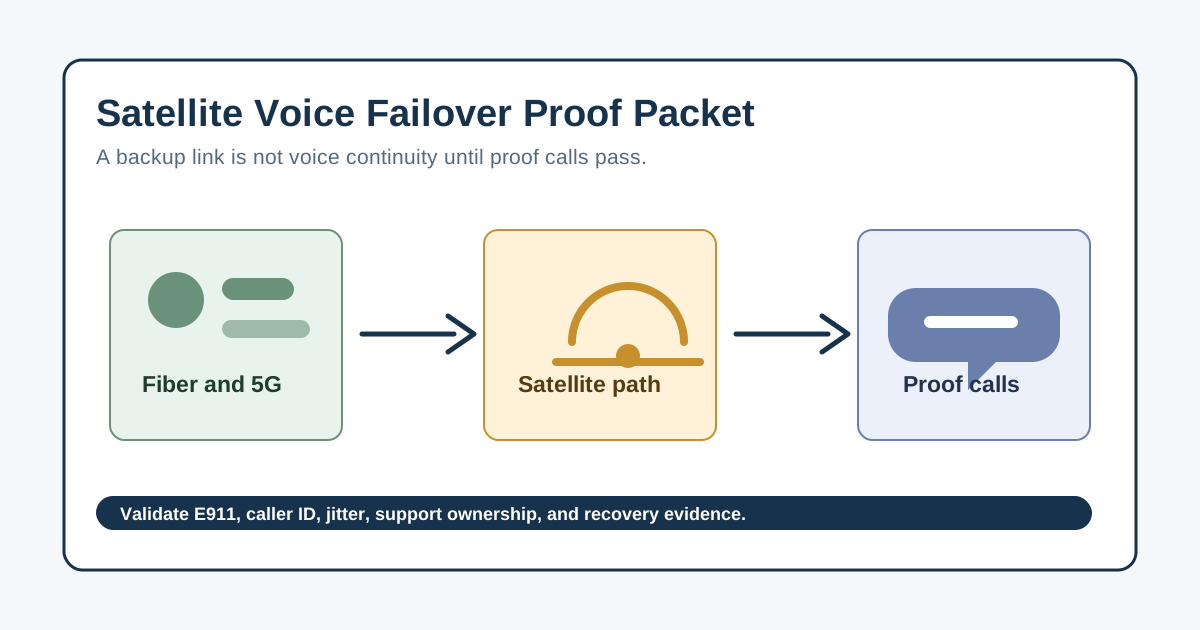
Satellite Voice Failover Proof Packet
A VoIP and UCaaS buyer framework for validating whether satellite broadband can protect business calling across access path, call quality, E911, power, support ownership, proof calls, and recovery evidence.
What buyers should do next
List the sites, numbers, queues, users and devices that would actually need voice continuity during a fiber or 5G outage.
Ask the provider which calling paths are covered by the satellite option and which remain best-effort or out of scope.
Run proof calls across inbound, outbound, queue, transfer, voicemail, recording, CRM logging and emergency-test scenarios.
Measure latency, jitter, packet loss, setup time, audio quality, call drops and recovery timing during controlled failover.
Confirm E911 location behavior, caller ID, callback number, support ownership, pricing assumptions and availability limits before procurement.
Use the VoIP Stack Index AI-ready VoIP audit and VoIP cost calculator to turn resilience claims into buying criteria.
Buyer bridge
Do the routing audit before buying the buzz.
The winning AI phone stack is the one that preserves context, controls fallback, and lets humans take over without making the customer repeat the story.
Run the AI-ready VoIP audit