
Direct answer
8x8 Klue Salesforce integration breach: what buyers need to know
8x8 reported in a June 23, 2026 Form 8-K that an unauthorized actor exploited a Klue Labs third-party API integration connected to its Salesforce CRM between June 11 and June 12. The company said the actor accessed and exfiltrated competitively sensitive information about current, former, and prospective customers, including fragmented contract and opportunity information, sales notes, and business contact details. 8x8 said its core information systems remained operational, but VoIP buyers should treat CRM integrations as data-exposure and continuity controls.
This brief cites the source announcement and translates the event into a buyer framework. Verify current vendor terms before changing phone, messaging, or AI routing.
What happened
- 8x8 said it learned on June 13 that a threat actor had exploited a third-party API integration between Klue Labs and its Salesforce CRM.
- The filing says unauthorized access occurred between June 11 and June 12 and involved customer, former customer, and prospective customer information.
- 8x8 said the exposed information included fragmented contract and opportunity data, sales notes, business contact details, and limited payment-card information.
- Cybersecurity Dive reported that Klue was investigating a supply-chain attack tied to Salesforce integrations and that Salesforce disabled the Klue app while the issue was investigated.
- The Hacker News reported that Klue attributed the incident to a compromised legacy credential and OAuth tokens used to query connected third-party platforms.
Why this is trending
- The incident connects security headlines to everyday revenue operations: call notes, CRM records, opportunities, and customer contact data.
- VoIP buyers increasingly connect phone systems, dialers, AI voice agents, call summaries, CRM notes, sales intelligence, and support workflows.
- The story shows that a phone stack can inherit risk from connected apps even when the core calling platform stays operational.
The VoIP Stack Index take
A VoIP buyer should not approve CRM, sales, and AI integrations only because the features look useful. The buyer needs proof of token scope, least-privilege access, audit logs, vendor offboarding, CRM field exposure, incident notices, and failover procedures if a connected app must be disabled quickly.
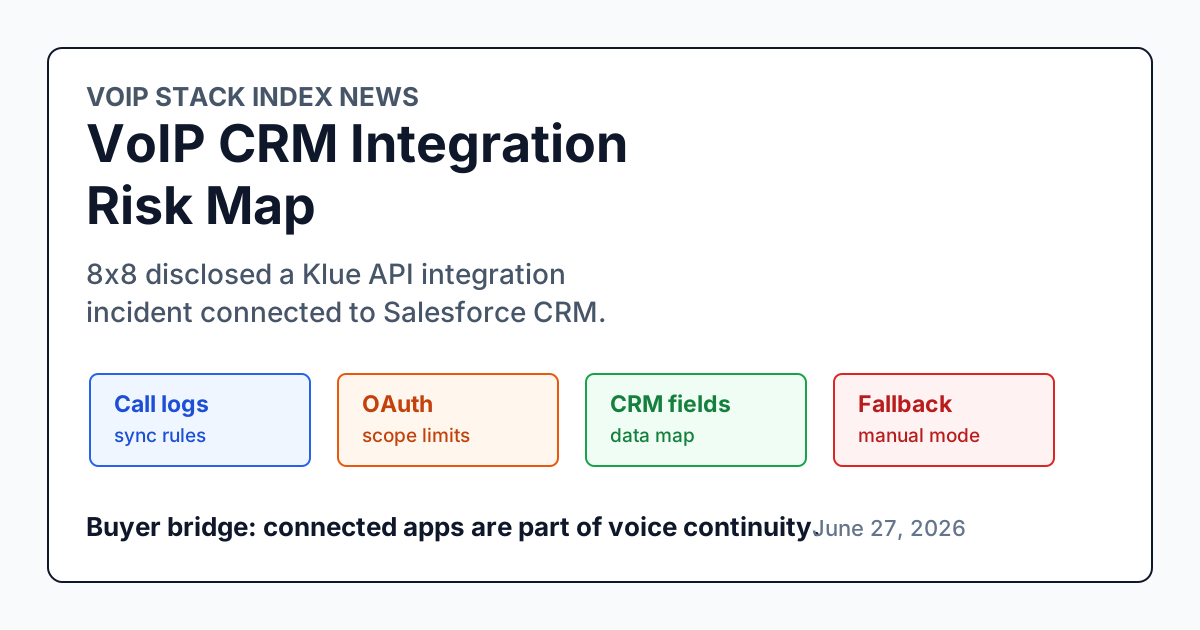
VoIP CRM Integration Risk Map
A buyer framework for checking connected-app tokens, CRM call logging, sales notes, support handoffs, contract data, and continuity controls before linking a phone stack to Salesforce or other CRM systems.
What buyers should do next
Inventory every connected app that can read or write CRM, call, contact, transcript, opportunity, or ticket data.
Require least-privilege OAuth scopes and remove unused sales-intelligence or enrichment integrations.
Ask VoIP vendors how call summaries, recordings, transcripts, and AI-generated notes are synced into CRM fields.
Create a CRM-disabled fallback process for call logging, escalations, and customer follow-up if a connected app is shut off.
Buyer bridge
Do the routing audit before buying the buzz.
The winning AI phone stack is the one that preserves context, controls fallback, and lets humans take over without making the customer repeat the story.
Run the AI-ready VoIP audit